
Is your water actually ready for fire season?
Every rural fire plan leans on water sources — ponds, tanks, dip sites, dry hydrants — that mostly sit unwatched between incidents. The worst time to learn a pond is three feet low or a tank valve seized is with smoke on the horizon. This is the pre-season checklist we'd run on any water source a response might depend on, and how monitoring keeps those answers current after the season starts.
The checklist
Run this on every pond, tank, dip site, and dry hydrant your response plans depend on — ideally before the season starts, and again after long dry spells.
1. Level and volume: is the water actually there?
- Measure the current level, don’t estimate it from the bank. Ponds shallow out from the edges, and a source that looks fine can be well below the depth drafting or dipping requires.
- Convert level to usable volume. A pond at half depth holds far less than half its water. Know the volume your plan credits the source with, and what it holds today.
- Check the depth at the draft or dip point specifically — the deepest usable spot, not the average.
2. Access: can apparatus and aircraft actually use it?
- Drive the access road with the vehicle that would respond, not a pickup. Washouts, soft shoulders, and new gates all appear over winter.
- Confirm turnaround and setup room at the draft site.
- For dip sites: reassess approach and departure paths for new obstructions — grown timber, new power lines, structures — and confirm the surface area still fits the bucket work planned there.
3. Hardware: valves, screens, and dry hydrants
- Exercise every valve you’d need under pressure of an incident. A seized valve found in May is maintenance; found during a fire, it’s a failed water source.
- Inspect dry hydrant strainers and couplings; flush if your schedule calls for it. NFPA 1142 (the Standard on Water Supplies for Suburban and Rural Fire Fighting) is the planning reference many rural departments use for stored-water and dry-hydrant installations — your authority having jurisdiction decides how it applies locally.
- Check tank vents, lids, and fittings — a vacuum-locked or debris-fouled tank drafts poorly.
4. Documentation: does dispatch know what you know?
- Update the source list your dispatch and neighboring agencies actually use: location, access notes, current usable volume, and any restrictions.
- Note the owner and contact for private sources, and confirm the arrangement still stands.
- Record the date of the check. An entry from three seasons ago is a rumor, not a plan.
The problem with a checklist: it’s true for a day
Everything above answers “is it ready today.” Levels fall all summer — evaporation, stock use, irrigation draws — and the sources that fail in August looked fine in May.
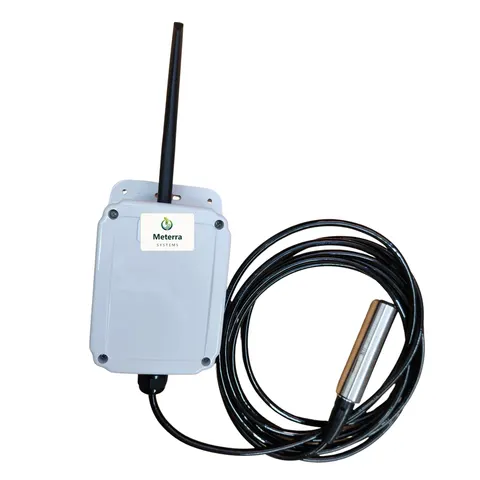
That’s the gap remote monitoring closes: a sensor on the pond, tank, or dip site reports level and estimated volume continuously, and alerts you when a source drops below the depth your plan needs — so the source list stays a fact, not a memory. Meterra data supports water-source planning and dispatch decisions; it does not replace agency procedures, dispatch information, or on-scene size-up.
If you want to prove it on one or two sources first, that’s exactly what the pilot program is for — and the grants guide maps programs, including FEMA AFG, that help rural departments fund water-supply readiness.
Conditions, watched for you
Know when your afternoon turns dangerous.
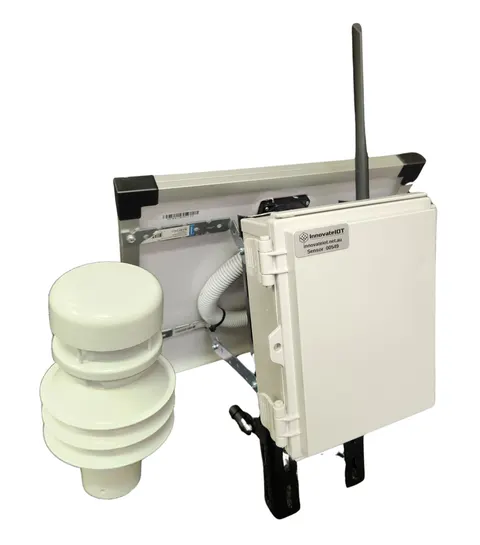
The weather station reads temperature, humidity, wind, and rainfall from your own ground and derives a fire-danger index (FBI) on-site — so the day that quietly crosses into dangerous conditions doesn’t stay quiet. Here’s an afternoon, sped up:
Sped-up illustration — the station reports temperature, humidity, wind, rainfall, Delta-T, and an on-site fire-danger index (FBI) derived from its own readings. It supports your planning; it doesn’t replace official fire-weather forecasts or agency warnings.
The products in this simulation
Every device reports to the same Meterra dashboard and app.
The hardware this guide covers
Every device reports to the same Meterra dashboard and app.
Tell us what you need to keep an eye on and we'll map the right sensors and coverage.
Frequently asked questions
When should the checklist be run?
Before your area's season starts — late spring for most of the Mountain West — and again after any long dry stretch. Levels move all summer, which is the argument for continuous monitoring on the sources that matter most; a spring check answers "is it ready today," not "will it be ready in August."
Who is this checklist for?
Anyone responsible for water a fire response might use — rural and volunteer fire departments, districts doing pre-attack planning, and landowners whose ponds and tanks are marked as drafting or dip sources. It's written to be practical rather than exhaustive, and it doesn't replace your agency's own procedures.
What water sources does NFPA 1142 cover?
NFPA 1142, the Standard on Water Supplies for Suburban and Rural Fire Fighting, is the reference many rural departments and insurance evaluators use for planning water supplies where there are no hydrants — including tanks, ponds, and dry hydrant installations. Your authority having jurisdiction decides how it applies locally; we cite it here as the standard to know, not as legal advice.
How does remote monitoring fit in?
The checklist answers "is it ready now." A sensor keeps answering that question every hour for the rest of the season — current level and estimated volume on a dashboard, with an alert when a source drops below the depth your plan needs. Meterra data supports water-source planning and dispatch decisions; it does not replace agency procedures or on-scene size-up.
Has Meterra deployed with US fire agencies?
Not yet — our named US deployments are municipal and industrial, and our fire-focused work runs on the same proven sensors. We're inviting the first US fire agencies to pilot the system on one to three water sources; the pilot program page explains how that works, and grant programs like FEMA AFG can help fund rural water-supply improvements.
Related Meterra pages
- Dam Level Monitor: usable depth in ponds and open sources, year-round.
- Tank Level Sensor: cisterns and storage tanks on the checklist.
- Wildfire Water Source Monitoring: the full picture, monitoring the sources your response plans on.
- Helicopter Dip Site Monitoring: depth and level for aerial water sources.
- Fire Water Supply Monitoring: NFPA 1142-style planning, dry hydrants, and stored water.
- Pilot Program: how the first US agency pilots work.
- Grants & Funding Guide: FEMA AFG and other programs that fund readiness.