
Know what's in the bin without climbing it.
Checking a feed bin or grain silo usually means a ladder, a guess, or a run-out you find out about when the auger goes empty. Meterra's Silo Level Sensor sits at the top of the bin and sends the level, the tonnage on hand, and a low-level alert to your phone. It is a non-contact ultrasonic sensor built for grain, feed pellets, and other dry bulk. No climbing, no power, no Wi-Fi.
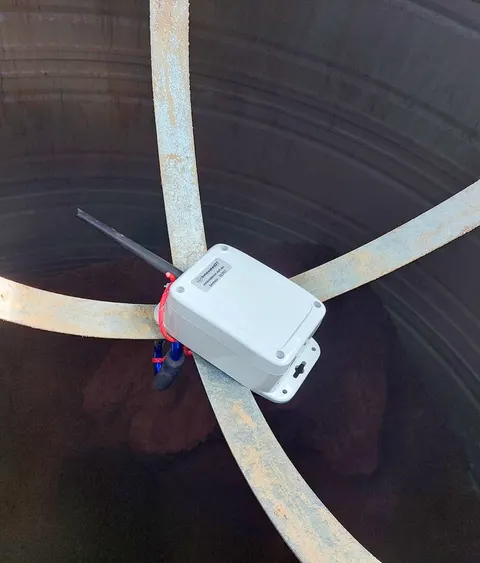
Climbing the bin is the old way to guess
A feed bin or grain silo only tells you what’s inside if you climb it, tap it, or wait for the auger to cough, and each of those is some mix of slow, inaccurate, and dangerous. The cost shows up as an empty bin nobody saw coming, a rushed delivery at a premium, or a climb up a ladder in bad weather to eyeball a number.
A sensor at the top of the bin makes that number something you read from your phone. It reports the level and the tonnage on hand and alerts you before the bin runs low, so reorders get scheduled and run-outs stop happening.
What Meterra watches
- Grain bins: corn, wheat, barley, and other stored grain.
- Feed bins and silos: bulk feed, pellets, and rations for livestock and dairy.
- Other dry bulk: the inputs and supplements you store in a bin and can’t afford to run dry.
Every bin reports to one dashboard with level, tonnage, trend, low-level alerts, and CSV export, across one site or many.
A sensor built for bins
The Silo Level Sensor is ultrasonic: it measures the distance down to the surface, so nothing touches the grain or feed and nothing sits in the bin to clog. The dashboard turns that distance into the level and the tonnage in the bin. For liquids like water, diesel, and fertilizer, the Tank Level Sensor does the same job on a tank.
Built for the yard
No power, no Wi-Fi, no hub. The sensor mounts at the top of the bin, runs 2+ years on its own battery, and reports over Verizon’s NB-IoT low-power cellular network, with LEO satellite where there’s no cell coverage, confirmed for your site before install.
A note on readings
Bin levels and tonnage are for planning and reordering, tuned to your bin’s shape and material: accurate enough to schedule deliveries and catch a run-out, which is the job. During a fill, airborne dust can briefly disturb a reading; the level settles and reports reliably between fills.
Getting started
Start with the bin that’s hurt you before: the one you’ve run dry, or the climb you’d rather not make. Tell us the bin, the material, and the coverage there, and we’ll set up the sensor and the low-level alert. The Silo Level Sensor is $450 with three months of connectivity included, and every sensor is backed by a 60-day money-back guarantee and a one-year warranty.
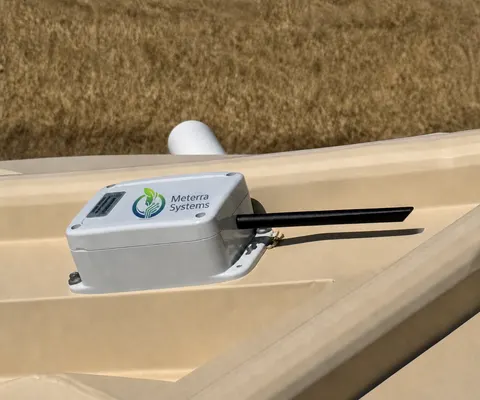
The hardware for this job
Every device reports to the same Meterra dashboard and app.
Tell us your site and we'll map the right sensors and coverage.
Frequently asked questions
What can the sensor measure?
Grain, feed pellets, and other dry bulk stored in a bin or silo. The dashboard shows the level and the tonnage on hand. For liquids like water, diesel, and liquid fertilizer, the Tank Level Sensor is the right fit.
Do I have to climb the bin to install it or read it?
You mount it once at the top of the bin, and after that you never climb to check a level again; it's all on your phone. The reading, the trend, and a low-level alert come to the app, so reorders and run-outs stop being a ladder-and-guess exercise.
Does dust affect the reading?
During filling or augering, airborne dust can disturb a reading for a moment, which is normal for any non-contact sensor. The level is reliable between fills, and we tune the setup to the bin and material so the numbers you act on are solid. Tell us the bin and what's in it and we'll set it up right.
Will it work out at the bin with no power or Wi-Fi?
Yes. The sensor runs 2+ years on its own battery and reports over Verizon's NB-IoT low-power cellular network, with LEO satellite where there's no cell coverage. No mains power, no Wi-Fi, no hub at the bin, and coverage is confirmed for your site first.
Can I get a low-level alert to reorder feed?
Yes. Set the level where you want to reorder and the sensor alerts you before the bin runs out, so you schedule deliveries instead of scrambling. Every bin reports to one dashboard with history and CSV export, so you can also track usage over time.
How much does it cost?
The Silo Level Sensor is $450, including three months of connectivity and full app access; connectivity is then from $10/month per device, with discounts on annual subscriptions. Every sensor is backed by a 60-day money-back guarantee and a one-year warranty.
Related Meterra solutions
- Silo Level Sensor: the ultrasonic sensor for grain, feed pellets, and dry bulk, with tonnage.
- Tank Level Sensor: the non-contact sensor for water, diesel, and liquid fertilizer tanks.
- Fuel Tank Monitoring: farm diesel and bulk fuel on the same dashboard as your bins.
- Farm Water Monitoring: the wider farm, with tanks, bins, and ponds on one dashboard.
- Cattle Ranch Monitoring: feed bins and water across a ranch, on one screen.