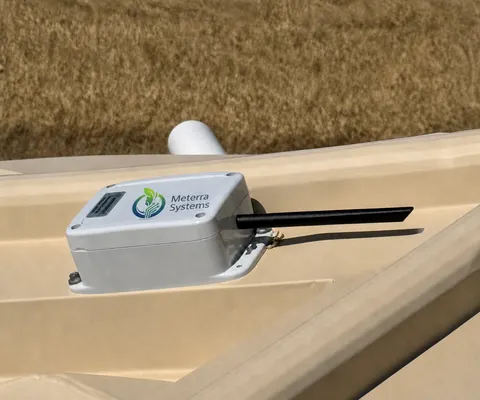
Your own weather, from your own ground.
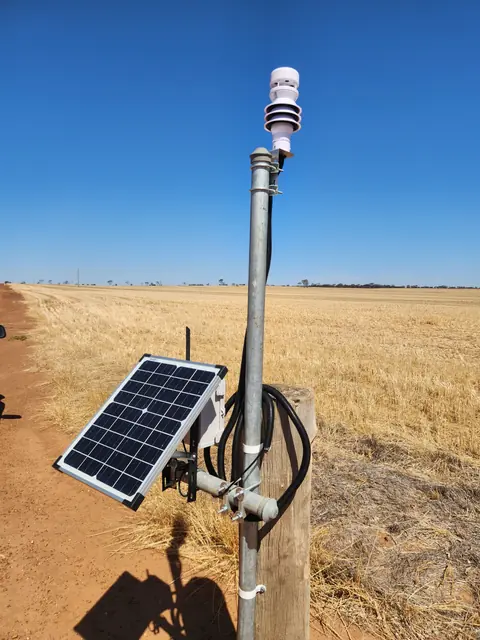
An all-in-one, solar-powered station with no moving parts: temperature, humidity, wind speed and direction, and rainfall from the place decisions actually get made, plus a fire-danger rating and Delta-T for spray windows.
Custom builds with added sensors cost more. Includes 3 months of connectivity and full dashboard + mobile app access. Connectivity then from $14/month per device; discounts on annual subscriptions.
Early adopter US launch pricing, expected to rise as the rollout grows. The price you order at is the price you pay.
Ships to order. Ask us for the current lead time.
$25 flat shipping per order by USPS (free when you order 2 or more), 2–5 business days in transit within the US. Shipping & returns
60-day money-back guarantee and a one-year warranty on every sensor.

Regional forecasts average away exactly the details that matter on the ground: the wind that picks up on your ridge, the frost that settles in your low field, the afternoon your place crosses into dangerous fire conditions. A station on-site reports what’s actually happening where your decisions land.
It’s the same station behind our remote weather monitoring work, reporting to the same dashboard as your tanks, ponds, and rain gauges, so conditions and water sit side by side.
Add-on sensors for custom builds
The standard station covers rain, temperature, humidity, wind speed and direction, Delta-T, a fire-danger rating, and frost alerts. When a decision on your place rides on something else, we can add sensors for it. Pick the ones that fit the job, and we’ll build them into your station.
Weather add-ons
- Solar radiation (pyranometer): Measures the sunlight reaching your site, a main driver of evapotranspiration (ET), the water crops and turf lose to the air. Orchards, vineyards, and golf courses use it to schedule irrigation on real demand.
- UV index: Measures the sun’s ultraviolet strength. Golf course and field crews use it to know when sun protection matters most, and apple growers watch it because sunburn browning comes from UV-B plus hot fruit surfaces.
- Barometric pressure: Tracks air pressure. A steady drop is an early sign of a storm or front, so fire districts, water districts, and ranchers can plan crews and field work ahead.
- Leaf wetness: Records how long leaves stay wet, the clock many fungal diseases run on, so vineyards and orchards can time sprays by disease risk instead of the calendar.
- Soil moisture and temperature: A probe in the ground beside the station reads root-zone moisture and soil temperature for irrigation and planting calls. For several depths, or ground away from the station, our Soil Moisture Probes are built for the job.
- Snow depth: Measures snow depth at the station. Mountain ranches and small water districts use it to follow storms and melt-out on their own ground, a local check to read alongside the NRCS snowpack reports that runoff forecasts are built on.
- Lightning detection: Counts strikes and gives a rough distance to the storm. Fire districts get a log of nearby strikes, so after a storm with little rain they know to watch for new starts over the next few days. It is a record, not a lightning alarm.
Air-quality add-ons
Air-quality sensors wire into the station’s communication board, so they read the air where the station stands. For the inside of a barn or a greenhouse, we can build a custom project that puts the sensor where it needs to be.
- Wildfire smoke (PM2.5 and PM10 particles): Counts airborne particles, including the fine PM2.5 that is the main health concern in wildfire smoke. Fire districts and rural operations get a local smoke trend to read alongside official air-quality reports.
- Ammonia (NH3): Measures ammonia gas from manure. Outdoors it usually stays low; inside dairy, poultry, and hog barns, rising ammonia shows ventilation falling behind, so barn monitoring is set up as a custom project.
- Hydrogen sulfide (H2S): Measures hydrogen sulfide, a toxic gas from manure pits and lagoons. Levels spike during agitation and pump-out, so a station that stands by the storage gives dairy and hog operations a record of those spikes.
- Carbon dioxide (CO2): Measures carbon dioxide. Outdoor air barely changes, so this one earns its place indoors: in confinement barns, rising CO2 means the air isn’t being exchanged fast enough, and in greenhouses it shows whether enrichment is working. Indoor setups are custom projects.
Add-ons are priced per build. Tell us what you want to measure and where the station will stand, and we’ll quote the complete build within one business day.
The smoke, ammonia, and hydrogen sulfide sensors give indicative readings for trends and awareness. None of the air-quality add-ons, carbon dioxide included, are EPA reference monitors or OSHA compliance instruments, and they don’t replace personal gas detectors or official air-quality reports. The ammonia and hydrogen sulfide sensors also drift over time and need periodic recalibration or replacement; we’ll spell out that upkeep, and how often it comes due, in the quote. The lightning detector is not a lightning safety plan: if you can hear thunder, you are close enough to be struck.
What you get
Decision data, not just weather data
Delta-T tells you when spray conditions are right; the fire-danger rating tells you when the day has turned dangerous; frost alerts protect what's in the ground. All from your site, not an airport 40 miles away.
Nothing to wear out
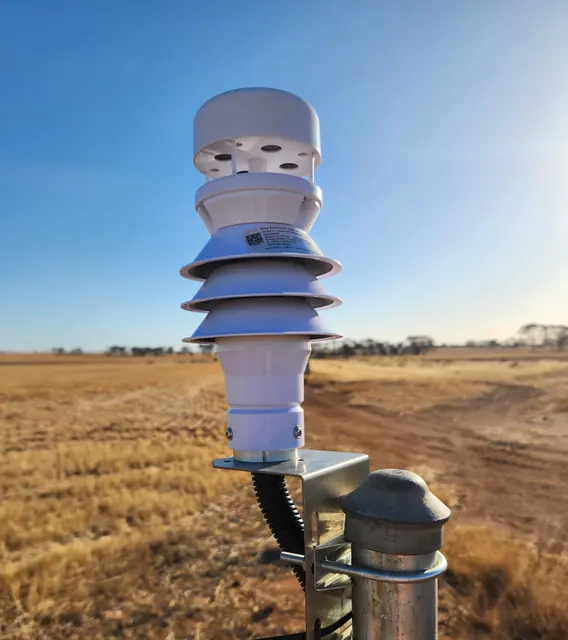
Ultrasonic wind sensing and radar rainfall mean no cups, vanes, or tipping parts: a station built to sit in rough conditions for years with minimal attention.
Off-grid by design
Independent solar power and cellular communications; includes a flange plate and 10 ft cable for pole mounting. Calibrates to your location.
How it works
Pole-mount the station
The included flange plate and 10 ft sensor cable make a clean pole install at your chosen site.
It powers and connects itself
Solar power and cellular reporting: no wiring, no Wi-Fi, and coverage confirmed for your location first.
Watch conditions with everything else
Weather joins water levels, flow, and rainfall on one dashboard, so conditions and consequences share the same screen.
Conditions, watched for you
Know when your afternoon turns dangerous.
The weather station reads temperature, humidity, wind, and rainfall from your own ground and derives a fire-danger index (FBI) on-site — so the day that quietly crosses into dangerous conditions doesn’t stay quiet. Here’s an afternoon, sped up:
Sped-up illustration — the station reports temperature, humidity, wind, rainfall, Delta-T, and an on-site fire-danger index (FBI) derived from its own readings. It supports your planning; it doesn’t replace official fire-weather forecasts or agency warnings.
The products in this simulation
Every device reports to the same Meterra dashboard and app.
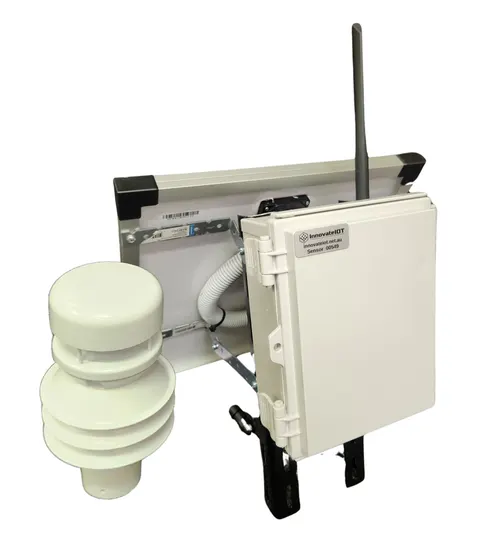
Send us your site details and we'll send back pricing and the right setup.
Specifications
| Reporting | New data every 15 minutes, with lifetime history |
|---|---|
| Measurements | Temperature (°F), humidity, wind speed and direction, rainfall |
| Wind sensing | Ultrasonic, no moving parts |
| Rainfall sensing | Radar, no tipping mechanism |
| Derived data | Fire-danger index, Delta-T, frost alerts |
| Add-on sensors | Solar radiation, UV, pressure, leaf wetness, soil, snow depth, lightning, smoke, ammonia, H2S, CO2 (custom builds) |
| Power | Independent solar with battery backup |
| Mounting | Flange plate and 10 ft (3 m) cable included |
| Connectivity | Verizon NB-IoT cellular (coverage confirmed for your location) |
| Compliance | FCC compliant |
| Price | Starting at $1,799 (custom builds with added sensors cost more) |
| Connectivity plan | 3 months included, then from $14/month per device (discounts on annual subscriptions) |
Price includes the sensor and 3 months of connectivity. US connectivity plans from $14/month per device after the bundled period; discounts on annual subscriptions. Prices exclude any required taxes.
Guides & documentation
- Product sheet Weather Station product sheet
Measurements, power, what is in the box, add-on sensors, and what the app and dashboard show, every 15 minutes.
All guides and sheets: Support.
Questions
How much does the weather station cost?
Starting at $1,799 for the standard station (rain, temperature, wind speed and direction, humidity, Delta-T, and fire-danger data), with three months of connectivity included, then $14/month. Custom builds can add more sensors and cost more; tell us what you want to measure and we'll quote it within one business day.
What sensors can be added to the weather station?
On a custom build we can add solar radiation, UV index, barometric pressure, leaf wetness, soil moisture and temperature, snow depth, and lightning detection, plus air-quality sensors for wildfire smoke (PM2.5 and PM10), ammonia, hydrogen sulfide, and carbon dioxide. Add-on sensors wire into the station's communication board, so they read the air and ground where the station stands; for the inside of a barn or greenhouse, we set them up as a custom project. Add-ons are priced per build and quoted with the complete station.
Are the air-quality sensors regulatory grade?
No. The smoke (PM2.5 and PM10), ammonia, and hydrogen sulfide sensors give indicative readings, which means they show trends and when levels are climbing. None of the air-quality add-ons, carbon dioxide included, are EPA reference monitors or OSHA compliance instruments, so use them for awareness alongside official air-quality reports, and keep personal gas detectors wherever people's safety is on the line.
Should I add soil moisture to the station or buy Soil Moisture Probes?
The station add-on reads the soil right beside the station, which suits one representative spot. If you want several depths, up to four probes on one device, or ground away from the station, the Soil Moisture Probes are the better choice.
What is Delta-T and why does it matter?
Delta-T combines temperature and humidity into a single number sprayers use to judge whether conditions will carry chemical where it's aimed. Too low and it drifts as fine droplets hang; too high and it evaporates before it lands. The station reports it live from your site, so the "spray or wait" call is made on your conditions.
How does the fire-danger rating work?
The station combines its local temperature, humidity, and wind readings into a location-based fire-danger index, a same-site indicator of how quickly conditions are turning dangerous. It supports your planning; it doesn't replace official fire-weather forecasts or agency warnings.
A practical place to start
Request pricing & availability
Share a few details and we’ll recommend the simplest setup that fits your operation, with clear pricing and coverage information.
60-day money-back guarantee and a one-year warranty on every sensor. In stock in the US. Orders ship within 1–2 business days.