
A pump quits at 2 a.m. You want to know at 2:01, not at dawn.
In aquaculture the water is life support, and it can fail fast — a stuck valve, a clogged screen, a pump that quit, and a tank or raceway drops while no one is watching. Meterra puts a wireless level sensor on a pond, raceway, or tank and sends an alert the instant the water falls past a safe level or drops unusually fast, so you reach the problem while there's still a cohort to save.
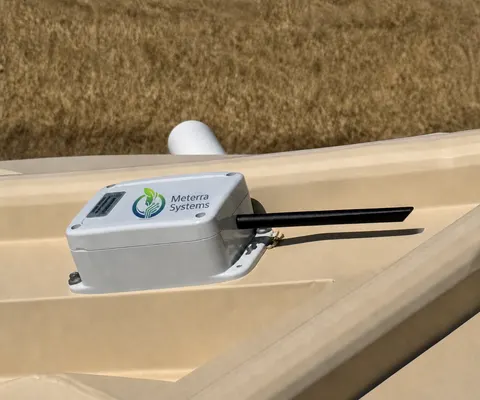
Minutes matter when it’s livestock under the water
A fish operation is unusually unforgiving about water. Cattle off water lose condition; fish out of water are gone in an afternoon. And the failures are quiet — a recirculating tank that stops filling, a raceway whose inflow dropped, a pond bleeding out through a cracked standpipe. By the time it’s visible at a walk-through, the cohort may already be lost.
Continuous level monitoring turns that silent failure into an alarm. A sensor watches the water around the clock and pages you the moment it crosses a safe level or falls faster than it should — the difference between resetting a pump and counting losses.
What Meterra watches
- Production ponds — level and trend, with a low-water and rapid-drop alarm.
- Raceways and tanks — a non-contact ultrasonic sensor above the water, nothing in with the stock.
- Head tanks, sumps, and reservoirs — confirm the supply feeding everything downstream is where it should be.
Every point reports to one dashboard with history and CSV export, and multi-user access so a manager and the on-call staff all get the same alarm.
Catch the failures that drain a system
A low level and a fast rate-of-change are the two signals that matter, and between them they flag the common failures — a stopped pump, a stuck or failed valve, a clogged screen, a knocked standpipe, a leak — early enough to act. Set the thresholds to your system and the alarm reaches whoever is closest.
Clean, non-contact sensing
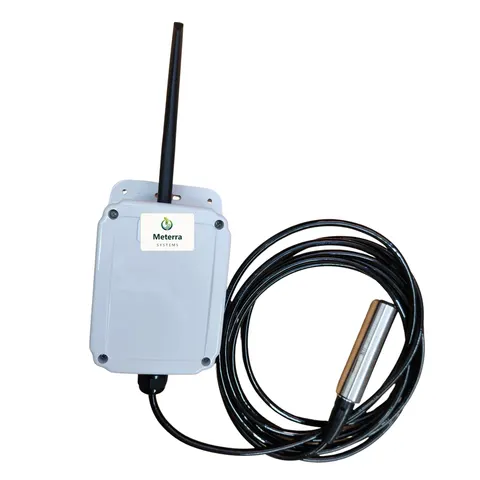
For tanks and raceways, the ultrasonic sensor reads the surface from above, so nothing sits in the water to foul or disturb stock. For ponds, a sealed pressure sensor is the alternative. Both run for years on their own power.
A note on scope
Meterra is a monitoring and alerting layer — it tells you fast when water is leaving a system. It is not a life-support controller and does not replace aeration, backup power, or the alarms your operation already relies on; it makes them better by catching the water problem early.
Getting started
Start with the system whose loss would hurt most — the hatchery raceway, the brood pond. Tell us the site and coverage, and we’ll set the sensor and the alarm thresholds with you.
The hardware for this job
Every device reports to the same Meterra dashboard and app.
Tell us about your operation and we'll map the right sensors and coverage.
Frequently asked questions
What does monitoring catch in an aquaculture system?
The failures that drain water away from stock — a pump that stopped, a valve that stuck, a screen that clogged, a standpipe knocked loose, a leak. A level sensor on the pond, raceway, or tank reports continuously and alarms the moment the water crosses a low threshold or falls unusually fast, which is the early signal that a system is losing water before the fish show stress.
How fast will I know?
Sensors report on a schedule and send an alarm immediately when a threshold or rate-of-change trips, by app and supported channels, to as many people as you put on the account. The whole point is to compress the gap between a failure and a person knowing about it — minutes, not the hours until the next walk-through.
Does anything go in the water with the fish?
It doesn't have to. A non-contact ultrasonic sensor mounts above the water and reads the surface, so nothing sits in the tank or raceway to disturb stock or foul. Where a submerged reading suits a pond better, a sealed pressure sensor is the alternative.
Can it monitor more than level?
Level and rapid-change are the core. The same platform carries flow sensors and water-quality sensors where a site needs them, and on-site weather, all into one app — but Meterra is a monitoring and alerting layer, not a life-support controller, so it complements your aeration and backup systems rather than replacing them.
Will it work at a remote pond site with no power or internet?
Yes. Sensors are battery or solar powered and report over Verizon's NB-IoT low-power cellular network, with LEO satellite where there's no cell coverage. No mains power, no Wi-Fi, no hub — coverage confirmed for your site first.
What does it cost?
In our US rollout, sensors start at $299 for the Tank Level Sensor and $499 for the Dam Level Monitor, each including three months of connectivity and full app access; connectivity is then from $10/month per device, with discounts on annual subscriptions. Tell us your tanks, raceways, and ponds and we'll size it. Every sensor is backed by a 60-day money-back guarantee and a one-year warranty.
Related Meterra pages
- Water Level Monitoring: how remote, non-contact level sensing works.
- Water Tank Monitoring: tanks, cisterns, and supply, with non-contact level and alarms.
- Tank Level Sensor: the non-contact ultrasonic sensor, with nothing in the water.
- Dam Level Monitor: the submerged pressure sensor for ponds.
- Pond & Dam Monitoring: open-water level sensing for production ponds.