
The million-gallon tank that went dark, and the $50–80k it didn't cost to fix.
Huntsville, a small town in northern Utah, watched its main storage tank through a sensor wired into the town SCADA system — until the buried line was cut. The quote to trench a new wire up the hill was $50,000 to $80,000. A wireless Meterra sensor put the tank back on screen for a fraction of that. This is the whole story.
- Customer
- Huntsville Town, Utah
- The site
- Million-gallon storage tank, about a mile up a steep hill
- Hardware
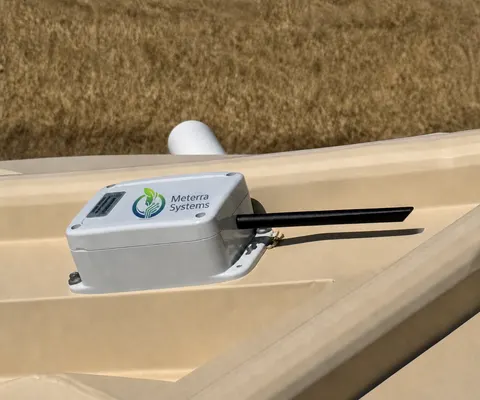
- One Meterra ultrasonic Tank Level Sensor
- Outcome
- Tank back on screen — no trench, no new wire
A tank a town depends on
Huntsville stores its drinking water in a million-gallon tank about a mile up a steep hill — the kind of site that’s easy to build on and hard to visit. For years the town watched it the traditional way: an ultrasonic level sensor at the tank, hard-wired into the town’s SCADA system through a buried control line running down the grade.
That’s a solid setup — right up until the wire.
The day the reading stopped
Buried control line fails the way it always does: suddenly, invisibly, and somewhere along its whole length. When Huntsville’s line was cut, the town lost its eyes on the tank. The sensor was fine. The tank was fine. The wire was the problem — and the quote to trench and replace it up that hill came in at $50,000 to $80,000.
That’s the quiet trap of wired monitoring: the sensor is a small fraction of the cost, and the wire is the rest. Every year it’s in the ground it gets older, and every repair means finding a break somewhere under a mile of hillside.
The wireless answer
Instead of rebuilding the wire, Huntsville put a Meterra remote ultrasonic sensor on the tank. It reports the same numbers the wired sensor did — current depth, gallons, gallons to fill, depth to fill, and tank-level percentage — but over the cellular network, with no line to cut and no trench to dig. The sensor runs on its own power, so there was nothing to run up the hill at all.
The town got its million-gallon tank back on screen for a fraction of the cost of the wire it would have replaced — and took a future failure mode off the books entirely. There is no longer a buried line to age, corrode, or meet a backhoe.
What a small system gets
The reading lands on a dashboard and phone app, with high- and low-level alarms that work after hours as readily as during them, a level history you can chart over any period, and CSV export for operating records. For a small town crew, that’s the practical difference: nobody drives up the hill to check a float, and nobody finds out about a problem from a customer call.
The pattern worth copying
Huntsville’s situation is common across rural water systems: a tank or reservoir that used to be monitored, a wired link that failed, and a repair quote that doesn’t fit a small system’s budget. The wireless version isn’t a compromise — it’s the same numbers, delivered without the part that kept breaking.
If your system has a tank that’s gone dark — or one that’s never been on screen at all — tell us about the site. We’ll confirm cellular coverage there and map what it would take to see it from your desk.
The hardware behind this result
Every device reports to the same Meterra dashboard and app.
Tell us your site and we'll map the right sensors and coverage.
Related Meterra pages
- Monitoring for Water Districts: what small systems watch, and how it stays affordable.
- Water Tank Monitoring: how remote level monitoring works on storage and supply tanks.
- SCADA Integration: when readings need to land in an existing control system.
- Tank Level Sensor: the wireless ultrasonic sensor Huntsville used.
- Reservoir Level Monitoring: irrigation and district reservoirs, with cable built to the site.