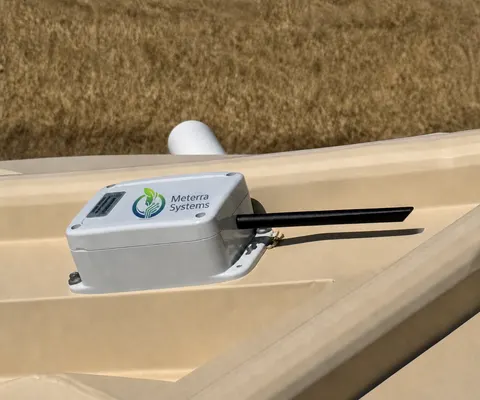
Know your frost pond is full before the night it has to be.
Overhead frost protection only works if the water lasts the whole cold night, and irrigation only works if the reservoir is still there in August. Meterra puts a wireless sensor on a frost-protection pond or irrigation reservoir and reports the level — plus on-site temperature and wind from the same weather station — so a grower knows the water and the conditions are there before the night or the dry spell that decides the crop.
Frost nights and dry Augusts don’t wait for a pond check
A vineyard or orchard runs on two water questions, and both get answered too late the old way. On a frost night, the question is will the pond outlast the cold — because overhead protection has to run without interruption, and a pond that empties at 3 a.m. turns a saved crop into a lost one. Through summer, the question is how much is left — because an irrigation reservoir drawn down faster than you thought leaves a block short at the worst time.
Driving out to read a staff gauge answers neither in time. A sensor at the pond answers both continuously: the level now, the trend over the night or the season, and an alert the moment it crosses a threshold you set.
What Meterra watches
- Frost-protection ponds — confirm the pond is full going into a frost event, and get alerted if it draws down faster than the run should.
- Irrigation reservoirs and ponds — season-long level and trend, with estimated volume on a defined pond and a low-water alert before you’re short.
- Supply and fill tanks — a non-contact ultrasonic sensor on any tank, nothing in the water.
Weather on the same dashboard
The same Meterra platform runs an industrial wireless weather station that reports temperature, wind speed and direction, humidity, rainfall and season-to-date totals, and Delta-T — the spray-timing metric — into the same app as your pond. So the conditions that start a frost night, or open a clean spray window, sit right next to the water they depend on. (It’s for hyperlocal awareness and your own decisions, not a replacement for official forecasts or your frost alarms.)
Built for the back blocks
No power, no Wi-Fi, no hub. Sensors run on battery or solar, install in minutes, and report over Verizon’s NB-IoT low-power cellular network, with LEO satellite where there’s no coverage — confirmed per site before install.
Funding help
Many western states fund water-efficiency work for growers. In Utah, for example, the state’s water-funding portal (including the Agricultural Water Optimization Program) supports on-farm projects, and USDA NRCS EQIP / WaterSMART cost-shares irrigation improvements. Eligibility is set by each program — confirm before you count on it.
Getting started
Start with the pond that protects the most valuable block, or the reservoir you most often wonder about. Tell us the site and the coverage there, and we’ll map the right sensor — and the weather station if you want the conditions on the same screen.
The hardware for this job
Every device reports to the same Meterra dashboard and app.
Tell us about your operation and we'll map the right sensors and coverage.
Frequently asked questions
Why monitor a frost-protection pond?
Overhead sprinkler frost protection releases heat as water freezes on the bud, but it has to run continuously from the moment you start until the thaw — often all night. Run the pond dry partway through and you not only lose the protection, you can leave wet buds exposed to worse damage. Knowing the pond is full before a frost event, and getting an alert if the level falls faster than expected while the system runs, is exactly the assurance the night calls for.
Can the same system tell me when to start frost protection?
The on-site weather station reports temperature, wind speed and direction, humidity, and Delta-T to the same app as the pond level, so the conditions that trigger a frost night show up next to the water that protects against it. It is for hyperlocal awareness and your own decision-making — not a replacement for your frost alarm thermometers or an official forecast.
What about irrigation reservoirs through the season?
The same sensor tracks a reservoir or pond level all season, with a trend that shows how fast you're drawing down and a low-water alert before you're short. On a defined pond it estimates volume, so water budgeting becomes a number instead of a guess.
Does the sensor go in the water?
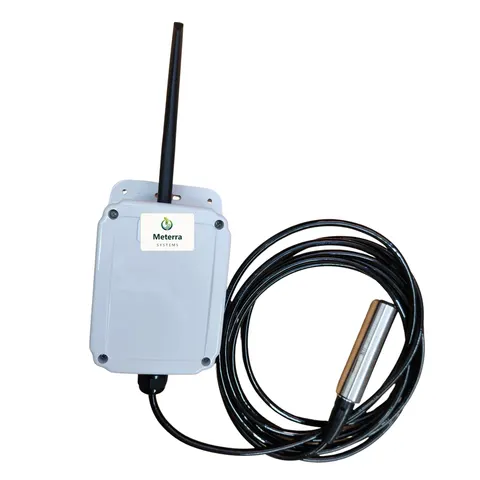
Your choice. A submerged pressure sensor reads depth from below the surface and keeps reading under ice; a non-contact ultrasonic sensor mounts above the water with nothing submerged. We match it to the site.
Will it reach a block with no power or Wi-Fi?
Yes. Sensors are battery or solar powered and report over Verizon's NB-IoT low-power cellular network, with LEO satellite where there's no cell coverage. No mains power, no Wi-Fi, no hub — coverage confirmed for your site first.
What does it cost, and can grants help?
In our US rollout, sensors start at $299 for the Tank Level Sensor and $499 for the Dam Level Monitor, each including three months of connectivity and full app access; connectivity is then from $10/month per device, with discounts on annual subscriptions. Water-efficiency work is often grant-supported — see the funding note below. Every sensor is backed by a 60-day money-back guarantee and a one-year warranty.
Related Meterra pages
- Pond & Dam Monitoring: how remote level sensing works on ponds and reservoirs.
- Remote Weather Monitoring: the on-site weather station (temperature, wind, rainfall, and Delta-T).
- Water Level Monitoring: the basics of remote level across all water.
- Dam Level Monitor: the submerged pressure sensor for ponds and reservoirs.
- Farm Water Monitoring: the wider farm, with tanks, ponds, and inputs on one dashboard.
- Delta-T and Spray Windows, Explained: when conditions are right to spray, read from a local weather station.
- Soil Moisture for Irrigation Decisions: using probe readings to decide when and how much to water.