What NFPA 1142 Requires for Rural Fire Water Supply
NFPA 1142 is the standard that answers one question: when there is no hydrant, how much water does the fire department need on site, and how do they get at it? It sets a minimum supply calculated from the size of the building, what is inside it, and how it is built, then adds rules about reaching and drafting that water. The number it produces is usually larger than people expect. And the part no standard can enforce is whether the water is still there on the day of the fire.
The short answer
NFPA 1142, the Standard on Water Supplies for Suburban and Rural Firefighting, exists because most of rural America has no hydrants. Where there is no pressurized system to plug into, the water has to be brought to the fire or drafted from something nearby, and somebody has to decide how much is enough. NFPA 1142 is the method for deciding.
It does two things. It gives a calculation that turns a building into a minimum number of gallons, and it sets expectations for the source itself so the water can actually be moved when an engine arrives. The 2027 edition, issued in 2026, is now the latest published edition; the 2022 edition remains the one most jurisdictions have adopted and enforce. Edition numbers matter less than adoption, though. Jurisdictions routinely enforce an older adopted edition for years, so the version your AHJ names is the version that governs your project.
One thing it does not do is apply itself. NFPA publishes standards; they carry weight only where a state, county, or fire district adopts them, often with local amendments. The office that issues your permit is the authority having jurisdiction, and their interpretation is the one that counts.
When it applies to you
The standard is aimed at areas where an adequate and reliable water supply for firefighting does not otherwise exist. The threshold usually cited is a system that cannot deliver about 250 gpm at 20 psi above average domestic demand. Below that, supplemental supply gets required.
Most people never read a word of NFPA 1142 until it arrives attached to something they want:
- A building permit for a new house, shop, or barn outside the water district.
- A subdivision or land-development approval, where the fire protection plan has to show a supply.
- An insurance conversation, where the carrier or a rating review asks what water is available.
- A fire district’s own planning, mapping designated sources across its response area.
The trigger is nearly always someone else’s, which is why the first move is not a tank catalog. It is a written statement from your AHJ of what they require and which edition or amendment they are enforcing.
NFPA 1142 is not NFPA 1140
Worth clearing up, because it sends people down the wrong path. NFPA consolidated a group of wildland documents into NFPA 1140, Standard for Wildland Fire Protection, absorbing NFPA 1051, 1141, 1143, and 1144. NFPA 1142 was not part of that consolidation. It is still a standalone standard with its own number and its own edition history, and the two standards are written to work together, with 1142 owning water supply.
So if you are looking for rural water supply requirements, 1142 is the document. If you are looking for structure ignition hazards, defensible space, or wildland infrastructure, that material moved into 1140.
How the minimum water supply is calculated
The calculation is arithmetic, and you can run it on the back of an envelope before you ever call anyone. The numbers that follow are the 2022 edition’s, the version most AHJs currently enforce; the newly issued 2027 edition revises the dwelling classifications in the direction of requiring more water, which is one more reason to confirm the edition your AHJ names. Three inputs and one optional multiplier:
1. Total volume of the structure, in cubic feet. Length times width, times the height. For the height you take the wall height of each floor and add half the distance from the top plate to the ridge, which is a reasonable way to account for the attic void without pretending the gable is a full storey.
2. The occupancy hazard classification number. This is where the standard classifies what the building is used for, on a scale that runs from severe hazard through high, moderate, low, and light. The numbers attached run roughly from 3 for the most severe down to 7 for the lightest.
3. The construction classification number. How the building is built, using the standard construction types: roughly 0.5 for Type I, 0.75 for Type II, 1.0 for Type III, 0.75 for Type IV heavy timber, and 1.5 for Type V wood frame.
The formula divides by the hazard number and multiplies by the construction number:
Minimum water supply = (total volume ÷ occupancy hazard number) × construction classification number
4. Exposures. If there are exposure hazards, another structure close enough to catch or contribute, the result gets multiplied by 1.5.
Then the floors apply. Whatever the math produces, the commonly applied minimums are 2,000 gallons where there are no exposure hazards and 3,000 gallons where there are.
The counterintuitive part
You divide by the occupancy hazard number, and the more dangerous occupancies carry the smaller number. A severe-hazard building divides by 3; a light-hazard one divides by 7. Same building volume, more than double the water.
This catches people out constantly, usually in the direction of under-building. If you are sizing a shop that will hold fuel, chemicals, or a woodworking operation, do not reason from what the neighbour’s house needed.
A worked example
A two-storey farmhouse, 30 ft by 40 ft, 9 ft walls on each floor, with the ridge 10 ft above the top plate:
- Volume: 30 × 40 = 1,200 sq ft footprint. Height: 9 + 9 + 5 = 23 ft. Total 27,600 cubic feet.
- Light hazard, so divide by 7: 27,600 ÷ 7 = 3,943.
- Type V wood frame, so multiply by 1.5: 3,943 × 1.5 = 5,914 gallons.
Call it 5,900 gallons for a fairly ordinary farmhouse. Put a barn close enough to count as an exposure and the same house needs 5,914 × 1.5, near 8,900 gallons.
That is the number that surprises people. It is well beyond a domestic pressure tank and beyond most single poly tanks, which is why rural supplies tend to end up as a large cistern, a pond with a dry hydrant, or a combination.
Run this yourself to get oriented, then have the AHJ confirm your classifications. The occupancy hazard call in particular is a judgement about use, and it is theirs to make.
What can serve as the supply
The standard is not prescriptive about the container so much as about the water being available and drawable. In practice, rural supplies come down to a few forms:
- Cisterns and storage tanks, buried or above ground, sized to the calculation and fitted with a suitable draft connection.
- Ponds and impoundments with a dry hydrant, which is a non-pressurized pipe set into the water so an engine can draft by suction.
- Streams and other open sources with a developed draft site, where flow is dependable year round.
- Tender shuttle capability, where the fire department can haul the required volume within the time the AHJ accepts, often relying on a fill site elsewhere.
Two conditions run through all of these. The water has to be there year round, including through the dry end of the season. And the fire department has to be able to reach it and get it out.
Getting the water out is half the requirement
A designated source that cannot be worked is not a source. The access details matter as much as the gallons:
- Suction lift and hose reach. A dry hydrant is expected to be reachable with a short run of hard suction hose, on the order of 20 ft, with the connection close to the edge of a road or pull-off. Drafting is a suction operation, and physics puts a hard ceiling on lift.
- All-weather access. An engine or tender is heavy. A route that works in July and turns to mud in March is a route the department cannot count on.
- Setback from the structure. Dry hydrants are generally kept a minimum distance from buildings, commonly 100 ft, so that the supply is not inside the fire.
- Depth over the strainer. The intake needs water above it, with margin, and the strainer needs to stay clear of silt and weed growth.
- Compatible connections. Thread and size have to match what the responding department actually carries.
If you are developing a source, this is the part to walk with your fire district before construction rather than after. They know their apparatus, their hose, and the road conditions they will face.
The gap no standard can close
Here is the honest limit of the whole exercise. NFPA 1142 sizes a supply and specifies how to reach it. Both are one-time determinations, checked when a source is designated and reviewed occasionally after that.
The water level is not a one-time fact. A cistern seeps or gets drawn down. A pond falls through a dry summer, sometimes below the strainer, and looks completely normal from the road while doing it. A dry hydrant silts in slowly. Nothing about the original calculation changes, and the paperwork stays valid, but the actual answer to “is there enough water here today” quietly becomes no.
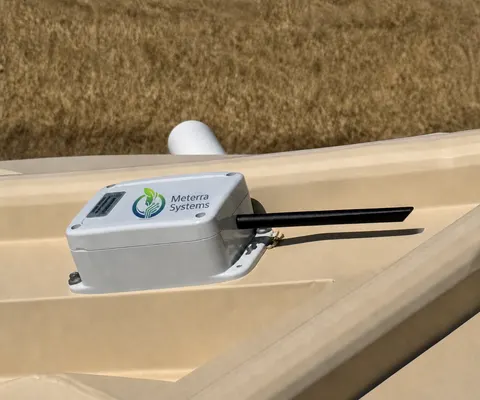
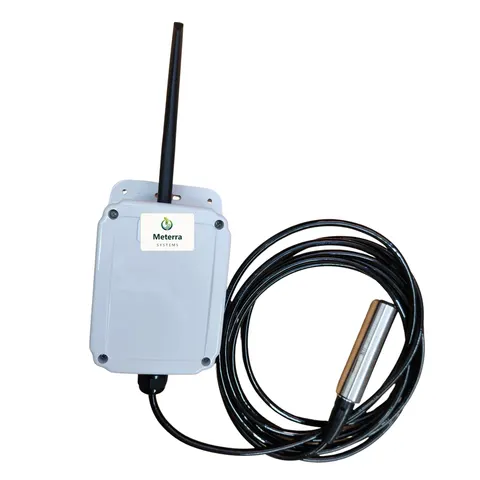
This is the specific problem fire water supply monitoring addresses. A sensor on the source reports level and usable volume continuously, alerts when it drops below draft depth, and keeps a history you can show a rating review or hand to a district. For an open pond or a draft site the Dam Level Monitor is a submerged pressure sensor that reads true depth and keeps reading under ice. For a cistern or steel tank the Tank Level Sensor mounts above the water with nothing inside the tank. Both run on battery or solar and report over low-power cellular, with satellite where there is no coverage, which matters because designated sources are usually at the end of the road by definition.
If you are working through readiness across several sources, our fire-season water readiness checklist covers the walk-around, and grants and funding lists programs that help fire departments and districts pay for water-supply and readiness equipment, including FEMA’s Assistance to Firefighters Grant and USDA Forest Service Volunteer Fire Assistance.
What we are not claiming
Monitoring does not create compliance, satisfy NFPA 1142, or certify anything. It does not change your required gallons, approve your source, or substitute for the fire district’s own inspection and a pump operator’s judgement at the draft. We are a monitoring and documentation layer, and we would rather say that plainly than let a permit decision rest on it.
Get your requirement in writing from your AHJ. Get the source built to what they approve. Then monitoring answers the one question the approval cannot: whether it is still true today.
Sizing a source, or trying to trust one you already have
Tell us what you are working with. The source type and rough dimensions, whether it is a cistern or open water, how far it sits from power and cell service, and whether this is one property or a district’s worth of sites. We will map the right sensor and confirm coverage at the specific location before you buy anything.
Call (385) 534-8200 and talk it through with a person, or request pricing below. Every sensor carries a 60-day money-back guarantee and a one-year warranty.
The hardware this guide covers
Every device reports to the same Meterra dashboard and app.
Tell us what you need to keep an eye on and we'll map the right sensors and coverage.
Frequently asked questions
Does NFPA 1142 apply to my property?
It applies where your authority having jurisdiction says it does. The standard is written for suburban and rural areas where a reliable pressurized water supply for firefighting does not otherwise exist, and it is commonly triggered when the available system cannot deliver on the order of 250 gpm at 20 psi above normal domestic use. In practice most people meet it as a condition on a building permit, a subdivision approval, or an insurance question. Your fire marshal or building department is the one who tells you whether it applies and in what form.
How many gallons will I actually need?
It depends on the volume of the structure, its occupancy hazard classification, and its construction type, run through the standard's formula. A modest two-story wood-frame farmhouse commonly lands in the several-thousand-gallon range, and a large shop, barn, or anything storing flammables goes up sharply from there. Minimum floors apply regardless of what the math produces, commonly cited as 2,000 gallons with no exposure hazards and 3,000 gallons where exposures exist. Have your AHJ confirm the classification numbers before you size a tank.
Is NFPA 1142 the same as NFPA 1140?
No, and this trips people up regularly. NFPA 1140, Standard for Wildland Fire Protection, consolidated several wildland documents including NFPA 1051, 1141, 1143, and 1144. NFPA 1142 was not part of that consolidation. It remains its own standard, Standard on Water Supplies for Suburban and Rural Firefighting, with its own edition history: the 2027 edition is now the latest published, while most jurisdictions still enforce the 2022 edition. The two standards are written to work together, with 1142 owning water supply. If someone tells you 1142 was withdrawn, they are thinking of a different document.
Can a pond, a stock tank, or a swimming pool count as the supply?
Often yes, if the water is reliably there year round and the fire department can actually draft it. That second condition is where sources fail. Drafting needs enough depth over the strainer, an access route an engine or tender can use in any weather, and a connection point close enough for hard suction hose. A pond that meets the gallon requirement in April and sits below draft depth in September is not a supply for the months that matter most.
Does NFPA 1142 require me to monitor the water level?
No. The standard addresses how much water is required and how it is accessed, not continuous instrumentation, and no sensor creates or certifies compliance. Monitoring is a practical answer to a real gap: a designated source is inspected occasionally and relied on constantly. A level sensor with a low-water alert tells you when a cistern or pond has dropped below usable depth, and keeps a record you can show. Useful, and worth doing, but it is your decision, not a requirement of the standard.
Who has the final say, NFPA or my local fire marshal?
Your AHJ. NFPA writes and publishes the standard; it has no force on its own. It becomes enforceable only when a state, county, or municipality adopts it, and jurisdictions routinely adopt it with amendments or apply their own fire-flow rules instead. Always get the requirement in writing from the office issuing your permit before you buy a tank or excavate a pond.
Related Meterra pages
- Fire Water Supply Monitoring: level, volume, and ready/low/dry status for a designated source.
- Fire-Season Water Readiness Checklist: the pre-season walk-through for sources, access, and valves.
- Fire Pond Monitoring: keeping a dry-hydrant pond above draft depth through the dry months.
- Grants & Funding: AFG, VFA, and cost-share programs that help pay for readiness equipment.
- Cistern Monitoring: non-contact level for the buried or above-ground tank itself.
- Dam Level Monitor: submerged pressure sensor for ponds and draft sites, reads under ice.