How to Track Rainfall Across Multiple Properties
Rain is the most local number in agriculture. Two inches at the house can be a quarter inch at the far place, and every decision that follows — turnout, hauling, planting, spraying — depends on what each property actually got, not what fell where you happened to be standing. A cellular rain gauge on each place logs every event with a timestamp and sends the totals to your phone, so the drive to check a tube becomes a glance at the app.
The problem with one gauge, or a neighbor’s number
Rainfall varies over surprisingly short distances, especially in storm country. A summer thunderstorm can drop an inch on one pasture and skip the next one entirely; mountain and bench ground splits weather even harder. If your only gauge is at the house, every other property is a guess — and the radar estimate or the co-op’s number thirty miles away doesn’t decide whether the far pond caught anything.
The decisions riding on that guess are real ones: whether a pasture is worth turning out on, whether the hauling run is still necessary, whether the seeding got watered in, whether a lease’s water is holding. Guessing wrong costs a drive at best and a dry week at worst.
What a remote gauge changes
A cellular rain gauge on each property replaces the guess with the number:
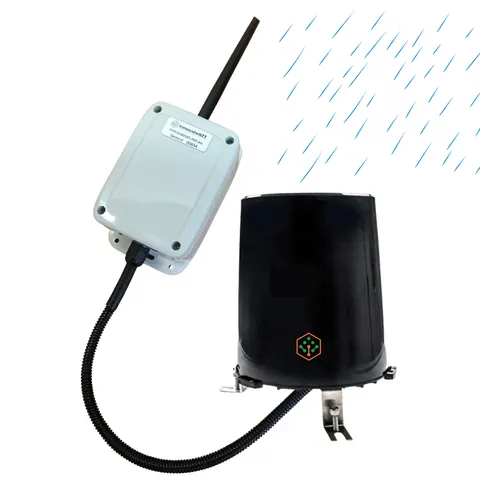
- Every event, timestamped. A tipping-bucket gauge counts rainfall in 0.008 in increments as it falls, so you see when it rained, how hard, and how much — not just a total.
- Totals by site, side by side. The dashboard shows each property’s rainfall next to its tank, trough, and pond levels — what fell, and what it did to your storage.
- Rain-detected alerts. Know it’s raining at the far place while it’s still raining, which matters when you’re deciding whether to start the truck.
- Season history that stays. Season-to-date and year-over-year records per site, useful for stocking decisions, lease conversations, and drought documentation.
Siting the gauge so the number is honest
A rain gauge is only as good as its spot. Three rules cover most of it:
- Open sky. Keep the gauge clear of trees, buildings, and rooflines — a common rule of thumb is a distance of at least twice the height of any nearby obstruction.
- Level and solid. Mount on a firm post or pole so wind doesn’t rock the mechanism and the funnel stays plumb.
- Away from artificial water. Sprinkler overshoot and spray drift read as rain. Keep it out of their reach.
After that, maintenance is a glance when you’re passing — the built-in insect and leaf filter handles the debris that quietly kills most unattended gauges.
Rain next to water: the full picture
The gauge earns its keep on its own, but it gets more useful next to the rest of the system. Rain on the same dashboard as tank and pond levels shows cause and effect: the half inch that fell, the pond that came up two inches — or didn’t, which is its own answer about where that water went. Add soil probes and you see the third chapter: what soaked in and what the ground is holding for the weeks ahead.
The hardware this guide covers
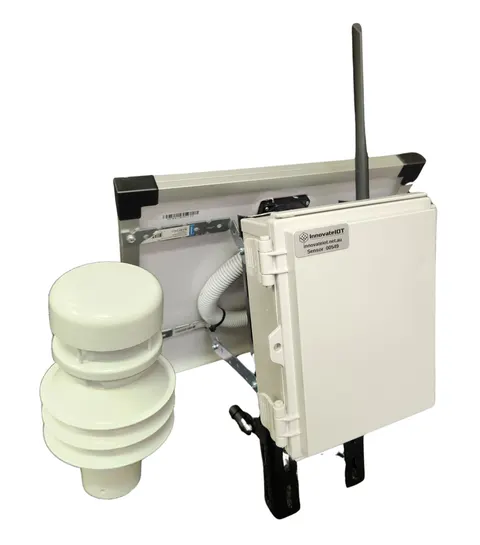
Every device reports to the same Meterra dashboard and app.
Tell us what you need to keep an eye on and we'll map the right sensors and coverage.
Frequently asked questions
How accurate are remote tipping-bucket rain gauges?
A quality tipping-bucket gauge resolves rainfall in 0.008 in (0.2 mm) increments — each tip of the internal bucket is one count, logged with a timestamp. That's finer resolution than reading a manual tube, and unlike a tube nothing evaporates between the storm and the reading.
Where should a rain gauge be mounted?
In the open, clear of trees, buildings, and rooflines that block or funnel rain — a good rule of thumb is to keep the gauge away from any obstruction by at least twice the obstruction's height. Mount it level on a post or pole, away from sprinkler and spray overshoot, and it will read what the sky actually delivered.
What ruins unattended rain gauges?
Debris, mostly — insects nesting in the funnel and leaves blocking the tipping mechanism are the classic quiet failures. A gauge built for remote duty has an insect and leaf filter screen ahead of the mechanism, plus a sealed housing, so it keeps reading between your visits.
Do I need cell service at each property?
The gauge reports over low-band cellular, which reaches farther than phone-grade service — many sites that can't hold a phone call still connect fine. We confirm coverage for each of your locations before anything ships.
Related Meterra pages
- Rain Gauge: the cellular tipping-bucket gauge this guide is about.
- Weather Station: rainfall plus temperature, wind, humidity, and fire-danger data from one unit.
- Remote Weather Monitoring: the full weather picture across your sites.
- Soil Moisture for Irrigation Decisions: what the rain did once it hit the ground.