
The Powder Mountain job: getting sewer ponds onto a legacy SCADA, wireless.
Above Eden, Utah, the Powder Mountain community's sewer system runs on evaporative ponds and a SCADA that was built for wired transmitters. We're putting a wireless level sensor in each pond and walking the readings straight into that existing system. No trenching, no new signal wire, no SCADA replacement. These videos were filmed on site as the job went in.
- The job
- The Powder Mountain job, Eden, Utah
- The sites
- Four evaporative sewer ponds on the plan, two of them in use today, plus the sanitary line above them
- Hardware
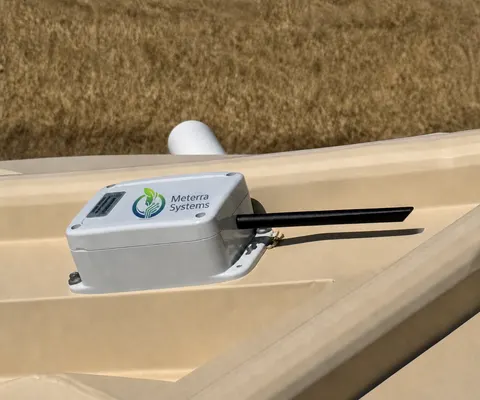
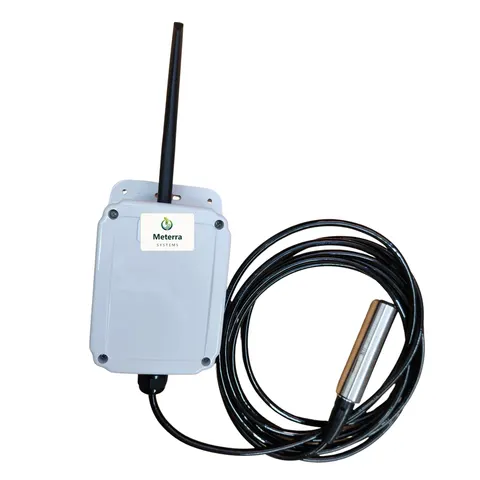
- Submerged pressure level sensors. A 15 ft cable in the first pond, and a 165 ft cable specced for the second so the sensor can sit nearer the middle. Ultrasonic sensors for the line study.
- Integration
- Readings bridged into the existing legacy SCADA, fully wireless, no new signal cable
- Status
- First pond sensor installed July 15, 2026 and reporting into the SCADA; the second pond is next, with four planned in total
What a mountain does to a sewer system
A sewer system on a mountain has problems a flatland system never meets: spring runoff that finds its way into the sanitary line, evaporative ponds that have to be watched, and a control room that expects every reading to arrive on a wire. The fix isn’t a new SCADA. It’s getting new eyes to report into the old one. That’s this job.
Pond level into a SCADA built for wired transmitters
The first pond got a 15 ft submerged pressure sensor. The reading travels wirelessly to the Meterra bridge, which hands it to the existing legacy SCADA looking exactly like the hardwired transmitter that system has always expected. That is the whole trick: no trench cut, no new signal wire pulled, no SCADA replaced.
It went in on July 15, 2026 and has read correctly ever since. The part that earns its keep is not the number on the screen, it is what the numbers show over time. They can see how much runoff a storm actually puts into the pond, and how far the water comes up afterward. They had never been able to see either one before.
165 ft of cable for a pond a few feet deep
The second evaporative pond is getting a 165 ft cable, and that number has nothing to do with how deep the water is. The pond is only a few feet deep at its deepest point. The cable is long because the sensor needs to sit nearer the middle of the pond, which is where the reading is most accurate for them, with enough cable left over to run back to the shoreline where the communication box sits on dry ground. 165 ft is one of our stocked lengths, so reaching the middle of that pond takes a longer cable, not a special build.
That is worth knowing before you spec a submerged sensor anywhere. Cable length buys reach, not just depth. These sensors are rated to about 330 ft (100 m) of water column, so depth is rarely what decides the order. More often the question is how far the sensor has to sit from the bank: a hard-to-reach spot, a problem area, the middle of open water. You put the sensor where the water actually needs watching, and the cable gets you back to shore. We build that cable to any length up to about 330 ft (100 m).
The line study comes with it
The same job includes finding where spring runoff gets into the sanitary line: ultrasonic sensors at multiple points, a dry-season baseline first, then point-to-point comparison during runoff to localize the infiltration. That method, and exactly where it stands, is laid out on Sewer Inflow & Infiltration Monitoring, with its own video from this job.
Where it stands, stated plainly
The first pond’s sensor went in on July 15, 2026 and has been reporting into the legacy SCADA ever since, giving them runoff and storm-response numbers they had never had. The second pond is next, and the plan runs to four ponds in total. The sanitary line study is part of the same job, and it gets its own status on Sewer Inflow & Infiltration Monitoring.
What we will not do is call the rest of it early. There are no savings figures and no repair outcome on this page, because the runoff season that produces them hasn’t run yet. When it does, the numbers will go here, and they’ll be theirs, not ours.
Running ponds, lagoons, or a collection system against a SCADA you’d rather not replace? Tell us what you run and we’ll tell you what it takes to get wireless readings into it: request pricing below or call (385) 534-8200.
The hardware behind this result
Every device reports to the same Meterra dashboard and app.
Tell us your site and we'll map the right sensors and coverage.
Related Meterra pages
- Wireless SCADA Integration: how a wireless reading lands in a legacy SCADA as if it were hardwired.
- Sewer Inflow & Infiltration Monitoring: the line-study method this job uses, explained step by step.
- Lift Station Monitoring: wet-well level and high-level alarms on the stations a collection system feeds.
- Wastewater & Lagoon Monitoring: level, freeboard, and alarms on treatment ponds and basins.
- Video: The Powder Mountain Job Overview: the custom monitoring job, explained on site.
- Video: Installing a Pond Sensor for a SCADA Tie-In: the install, start to finish.
- Video: Dam Level Sensor for an Evaporative Sewer Pond: why a shallow sewer pond gets a 165 ft sensor cable: reach, not depth.
- Video: Ultrasonic Flow Monitoring on a Sewer Job: reading depth in a sewer line from above, without touching the flow.