EQIP cost-share for livestock water: how it actually works
Half of every state's EQIP money is required to go to livestock-related practices, which is the most encouraging fact in the program and almost nobody knows it. The rule that catches people out is at the other end: start the work before your contract is approved and that work cannot be paid for, ever. Here is the sequence, the practice codes that make up a water system, the prerequisites that stall applications, and the honest answer on whether monitoring equipment is covered.
Start with the fact nobody mentions
NRCS policy requires states to target at least half of available EQIP funds to livestock-related practices. Additional floors apply for wildlife habitat, for beginning farmers and ranchers, and for socially disadvantaged farmers and ranchers, and states must run separate funding opportunities for the last two, with preference for veterans competing in those pools.
That target is written into NRCS’s own program manual (Title 440, Part 530, amended December 2025). Two things worth knowing as of early October 2026. The money is not in doubt: NRCS says the 2025 budget reconciliation law authorizes EQIP through fiscal year 2031, and states have begun announcing fiscal year 2027 cutoffs. The statute that carries the livestock target, though, has been kept alive by farm bill extensions, the latest of which ended on September 30, 2026 while Congress negotiates a replacement, so ask your field office whether your state is applying the target as usual this year.
If you run livestock and you have never applied because you assumed the money goes to row-crop irrigation, that assumption is backwards. Half of it is set aside for your category, and if you are a beginning or socially disadvantaged producer you may be competing in a smaller pool than you think.
We are not going to tell you what percentage of applications get funded, because we could not find a current government figure and the number that circulates online is unsourced. The set-aside is the honest encouragement, and it is verifiable.
How the program actually runs
EQIP is administered by the USDA Natural Resources Conservation Service under 7 CFR Part 1466. It provides financial and technical assistance to put conservation practices on the ground.
It is continuous sign-up with periodic ranking cutoffs, which confuses people constantly. You can apply any day of the year. What matters is your state’s ranking date, because applications are scored competitively in funding pools at those cutoffs. Miss one and your application is automatically deferred to the next funding period. It is not thrown out.
The sequence:
- Apply at your local USDA Service Center or NRCS field office, any time.
- Establish eligibility. Payment eligibility and adjusted gross income, compliance with highly erodible land and wetland provisions, documented control of the land, and the entity member list if you farm through an LLC or partnership.
- Plan with NRCS, producing an EQIP plan of operations with objectives, the practices, and an implementation schedule.
- Ranking. Your application is scored against others in its pool on cost effectiveness, magnitude of conservation benefit, priority of the resource concern, and willingness to complete the work promptly.
- Contract approval. NRCS is the approving authority.
- Then, and only then, build it. See the next section, because this is where money gets lost.
- Certify completion. NRCS or an approved technical service provider certifies the practice meets the Field Office Technical Guide standard. Build to spec or you do not get paid.
- Operate and maintain the practice for its designed lifespan.
Worth knowing about the ranking: NRCS may not rank an application higher purely because it is the cheapest, where conservation benefits are comparable. Underbidding is not a strategy.
The rule that costs people the whole project
The regulation bars payment for a practice that was initiated before application, and separately for one initiated before contract approval. Both bars are live at once.
In practice that means the well you drilled in August, while your application sat in a ranking pool, is not a fundable well. Not at a reduced rate. Not at all.
There is an early start waiver, and it must be approved in advance. The regulation and the NRCS manual differ slightly on which official signs it, so ask your field office who approves it rather than assuming.
The related trap is more subtle. Practices are ineligible if they are already implemented, unless the new work achieves a higher level of conservation benefit, though a practice past its established lifespan may be reapplied. And a practice whose sole purpose is to enhance or protect production without addressing a natural resource concern is ineligible outright. That last one is the reason an application framed as “I want a better trough” performs worse than one framed around distribution, riparian pressure, or drought resilience.
The practice codes, and why you should submit several
These are the codes that build a livestock water system. Every one below was verified as current:
| Code | Practice | Role in the system |
|---|---|---|
| 614 | Watering Facility | The trough or tank itself |
| 516 | Livestock Pipeline | Conveyance from source to facility |
| 642 | Water Well | Drilled or improved source |
| 574 | Spring Development | Collecting and protecting a spring or seep |
| 533 | Pumping Plant | Pump and power unit |
| 378 | Pond | Impoundment as a source |
| 382 | Fence | Exclusion fencing and cross-fencing |
| 528 | Grazing Management | The management practice that makes the water useful (older NRCS materials call it Prescribed Grazing) |
Here is the strategic point, and it is sourced rather than folklore. Ranking explicitly rewards applications that complete a conservation system or improve existing practices. A lone trough is a component. A source, a pipeline, a pumping plant, a facility, fencing, and a grazing plan submitted together is a system, and the scoring is built to notice the difference. Talk to your field office about the whole water plan, not the one thing you were going to buy anyway.
One code confusion to avoid. 516 Livestock Pipeline and 430 Irrigation Pipeline are different practices. That matters more than it sounds, because water conservation and irrigation practices are ineligible on land that was not irrigated in at least two of the last five years, absent a waiver. If your application gets built around the irrigation code by accident, it can collide with a rule that has nothing to do with what you are trying to do.
What it pays
The ceilings come straight from the regulation:
- 75 percent of estimated costs incurred, as the general maximum
- 100 percent of income foregone
- Historically underserved producers: the applicable rate plus at least a quarter more, capped at 90 percent of estimated costs
- High priority practices, up to 10 designated per state with State Technical Committee input, and explicitly able to include practices conserving water to address drought and declining aquifers: up to 90 percent
That last one is worth a phone call. Ask your state whether any livestock water practice is on its high priority list, because the difference between the general rate and the high priority rate on a whole water system is real money.
There is no national dollar figure, and be sceptical of anyone who quotes you one. Payments come from your state’s payment schedule, which prices practice scenarios using regional average costs. NRCS’s own payment schedule handbook is explicit that your actual cost does not set the payment; the schedule’s estimate does. The schedule for your state and fiscal year is published, and NRCS is required to make payment rates and program implementation information public, so you are entitled to see it before you commit.
Advance payments exist, and only for historically underserved producers. NRCS may advance at least half and up to all of the anticipated cost of materials and services, after an NRCS-approved design, with the funds to be spent within 90 days or returned, and the advance may be assigned to a vendor. If capital to front a water system is the actual obstacle, this is the paragraph to ask about.
You cannot stack to more than the full cost. Combined USDA payments may not exceed 100 percent of estimated incurred costs, and you cannot take EQIP payment for the same practice addressing the same resource concern on the same land as another USDA conservation program.
Finding your state’s dates, without getting burned
There is no national deadline, so this is a lookup, not a fact to memorise.
- The NRCS application cutoff dates page at
nrcs.usda.gov/application-cutoff-dates(it used to sit at/ranking-dates, which now redirects there) is the canonical source. - Your local USDA Service Center. For a first-time applicant this is the better starting point anyway, because the person there knows your state’s pools.
- Your state NRCS office news page, where cutoffs get announced.
A warning that matters more than the list. Last year’s ranking dates stay online and read exactly like current ones. The federal fiscal year turned over on October 1, NRCS now lists FY 2027 cutoffs for most states, and many of them have already passed. If yours has, apply anyway: NRCS says an application that arrives after the cutoff is automatically considered in a later funding cycle. If you find a specific date in a search result, check the fiscal year it belongs to before you plan around it. Missing a cycle by trusting a stale date is the most common way this goes wrong, and it costs a year.
For the same reason, we are not printing dates on this page. A date here would be wrong within weeks and would look authoritative while being wrong.
Does EQIP pay for remote monitoring? Sometimes, and not the way you would expect
We sell water monitoring, so treat this section as evidence that the rest of the page is straight.
The livestock water practices themselves do not pay for it. The program’s authorized cost categories are materials, equipment for installation, labor, mobilization, acquisition of technical knowledge, and income foregone. Payment is gated on the practice meeting its Field Office Technical Guide standard, so you are paid for the scope of that standard, not for additions to it.
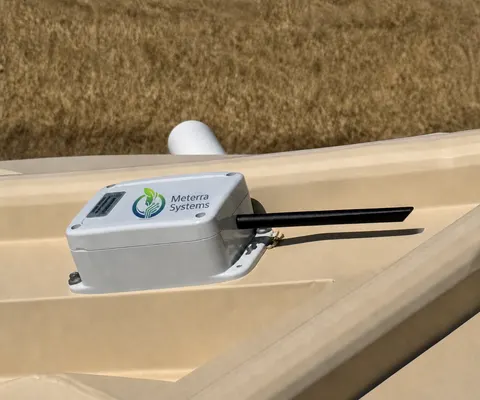
In some states, monitoring is paid as its own line. NRCS published a Livestock Water Monitoring Systems fact sheet in May 2025, and it is linked from the national Watering Facility (614) standard page under innovative technologies. It says financial assistance may be available through EQIP under practice 374, Energy Efficient Agricultural Operation, for monitoring installed with a new livestock watering facility. Whether that is real where you live is a state payment schedule question. The fiscal year 2026 schedules for Missouri and West Virginia list an automatic controller with telemetry under 374; the Kansas schedule carries 374 but has no such line. The fact sheet is guidance, not a promise, and your state’s schedule decides.
For a facility you already have, the route is a different program. The same fact sheet points to the Conservation Stewardship Program, which has its own eligibility rules, and names an enhancement for adding telemetry to an existing watering facility. NRCS simplified its CSP activity list for fiscal year 2026 and dropped the old enhancement codes, so ask whether that activity survived in your state before you plan around it.
Two more honest qualifications, because a flat yes would be as wrong as a flat no.
NRCS also funds monitoring where it has defined a monitoring activity. Edge-of-field water quality monitoring is a real, funded NRCS activity, and it appears in state payment schedules. It is a water quality tool, not a stock tank tool.
Controls and metering integral to a pumping plant are a different question. State technical material carries construction specifications for valves and meters, solar pumps, and variable frequency drives. Whether any particular state’s Pumping Plant payment scenario includes a control package is a state schedule question. Ask. We are not going to answer it for you and neither should anyone else.
The useful way to hold all of this: EQIP builds the water system, and monitoring is a separate line that some states fund and some do not. Ask your field office whether your state’s schedule has a telemetry component and what it requires, rather than adding a monitoring line on your own reading of this page, ours included. An unsupported line item is a good way to have it stripped at contract and to slow everything else down. And the contract-approval rule covers the hardware too: if it is meant to be in the contract, it does not get bought first.
What to do this week
If a water development is somewhere on your list for next year, the single highest value action is not reading more about the program. It is calling your local NRCS field office and getting a conservation planning conversation started, because the plan, the eligibility paperwork and the ranking pool all take longer than people expect, and none of the work can start until a contract exists.
Bring the whole picture rather than the one purchase: where the water comes from, where stock are not grazing because they cannot drink there, and what the grazing plan would look like if they could. That is the shape of application the ranking criteria are written to reward.
Once the system is in, livestock water monitoring is what keeps you from finding out about a failure on your next trip out. Whether any of that is covered depends on your state’s payment schedule, so plan on paying for it yourself unless your field office confirms a covered line, and we would rather you knew that going in. For the wider set of programs, including the fire and public agency grants that work differently from EQIP, see grants and funding.
Tell us what you need to keep an eye on and we'll map the right sensors and coverage.
Frequently asked questions
What practice codes cover livestock water under EQIP?
A water system is usually several practices submitted together rather than one. The core codes are 614 Watering Facility for the trough or tank, 516 Livestock Pipeline for the conveyance, 642 Water Well or 574 Spring Development for the source, and 533 Pumping Plant for the pump and power unit. Around those, 378 Pond, 382 Fence for exclusion or cross-fencing, and 528 Grazing Management (older NRCS materials call it Prescribed Grazing) frequently appear. NRCS's own materials list 614 as commonly applied alongside 642, 516, 574, 382, 378 and 528, which is a good indication of how the agency expects to see them.
When are EQIP applications due?
There is no national deadline. NRCS accepts applications year round, and each state sets its own ranking cutoff dates for each funding cycle. Applications that arrive after a cutoff are automatically deferred to the next funding period rather than rejected. Look up your own state's dates at the NRCS application cutoff dates page or ask your local USDA Service Center, and do not trust a date you found in a search result, because last year's cutoffs stay online and read exactly like current ones.
Can I start the work while I wait for approval?
No, and this is the most expensive mistake in the program. The regulation bars payment for a practice that was initiated before application, and separately for one initiated before contract approval. Both bars apply. If you drill the well while your application is being ranked, that well cannot be paid for. There is an early start waiver, but it has to be approved in advance, not explained afterwards.
What percentage does EQIP pay?
The general maximum is 75 percent of estimated costs incurred for the practice, and 100 percent of income foregone. Historically underserved producers get an increased rate, at least a quarter above the applicable rate, capped at 90 percent of estimated costs. Practices a state designates as high priority, which can include water practices addressing drought and declining aquifers, may also go up to 90 percent. The actual dollars come from your state's payment schedule, which prices practice scenarios using regional average costs, so there is no national dollar figure for a trough or a foot of pipeline.
Does EQIP pay for remote water monitoring or telemetry?
Sometimes, but not through the livestock water practices themselves, and not in every state. EQIP pays to install practices built to an NRCS technical standard, in the authorized cost categories of materials, installation equipment, labor, mobilization, technical knowledge and income foregone, so monitoring is only paid where a state schedule carries it as its own line. NRCS's livestock water monitoring fact sheet (May 2025) says EQIP assistance may be available under practice 374, Energy Efficient Agricultural Operation, for monitoring installed with a new livestock watering facility. Some state schedules list an automatic controller with telemetry under 374, and others do not. For a facility you already have, the same fact sheet points to the Conservation Stewardship Program, a separate program, and NRCS simplified its CSP activity list for fiscal year 2026, so ask whether that activity still exists in your state. NRCS also funds monitoring where it created a specific activity, such as edge-of-field water quality monitoring. Ask your field office before you buy anything, because hardware bought before contract approval cannot be paid for.
What stalls an EQIP application?
The common ones are documentation rather than conservation. You need control of the land for the full contract term, and a tenant may need written concurrence from the landowner. You need payment eligibility and adjusted gross income confirmed, and compliance with highly erodible land and wetland provisions. An entity such as an LLC or family partnership must supply a list of all members with tax identification numbers and percentage interest. A site specific environmental assessment can add time where ground disturbance has not already been analysed. And failing to maintain a practice EQIP funded previously counts against you in ranking.
Related Meterra pages
- Grants and Funding for Remote Water Monitoring: the wider list of programs, including fire and public agency grants.
- Reduce Water Hauling Trips: the operating cost a new water point is meant to remove.
- Livestock Water Monitoring: what happens after the water system is built.
- How Much Water Do Cattle Drink Per Day?: the demand math behind sizing a facility.