How to Keep Algae Out of Stock Tanks and Water Troughs
Algae needs three things to grow in a trough: sunlight, warmth, and nutrients from manure, feed, and slobber. Take away any one of them and you slow it down. In practice that means scrubbing on a schedule, keeping the water turning over instead of sitting, cutting the sunlight, and keeping feed and cattle out of the tank. Bleach and copper sulfate both work as maintenance treatments, though extension services disagree about the right dose by a surprising margin. Goldfish, the most popular advice on the internet, failed the one controlled trial anybody ran.
Reviewed by Dr. Nicole Sorensen, DVM · Mtn Green Animal Hospital · Agave Animal Hospital · August 2026

Why it is there in the first place
Algae needs sunlight, warmth, and nutrients, and a stock tank in July supplies all three. The nutrients are the part people underestimate: they come from cattle themselves. Slobber, manure, urine, and the feed dust and hay chaff that blow in are what feed a bloom, which is why the tank nearest the hay ring always goes green first. Ohio State Extension puts the sunlight requirement plainly, noting that algae cannot grow without sunlight.
Warmth compounds it. In a University of Minnesota trial that actually measured tank water, every one degree rise in water temperature came with measurable increases in dissolved solids and turbidity, and plastic tanks fouled worse than metal ones, carrying nearly double the chlorophyll.
So the levers are: less sun, fewer nutrients, cooler water, and water that moves instead of sitting. Everything below is one of those four, or a chemical that buys you time between them.
The remedies, ranked honestly
Scrubbing and turnover, which is the one that works
Nothing on this list beats a brush and a tank that empties and refills. Algae grows on surfaces, so physically removing the film sets the clock back further than any additive.
The awkward part is that published cleaning schedules range from daily to twice a year. That looks like disagreement, but the sources are answering different questions. The algae-focused advice, like Penn State’s, says weekly or as-needed. The sanitation-focused advice, like UGA’s, says a chemical disinfection at least twice a year. Do both jobs: a stiff long-handled brush weekly through the heat, and a real drain, scrub, and 10 percent bleach rinse in spring before it gets hot.
Turnover is the half people skip. A tank sized far larger than the herd draws down is a tank of standing water, and standing water is what blooms. Ohio State’s watering-system fact sheet is the rare source with real numbers: for group watering, size the tank to hold at least 25 percent of the daily herd requirement and set it up so refill takes no more than an hour. Match the tank to the herd, and the water replaces itself faster than algae can establish.
Bleach
Unscented household bleach is the most commonly recommended maintenance treatment, and the published rates disagree by a factor of five to eight.
Most beef extension services cluster around 2 to 3 ounces per 50 gallons, weekly, including NC State, Alabama, and Nebraska. UGA publishes 8 ounces per 1,000 gallons, notes that this works out to about 3 ppm of chlorine, and calls that safe for cattle to drink. Both are extension sources. Both are published. They are not the same number.
Hold times are equally scattered, from “no withdrawal time required” to a full hour. Given all that, the defensible approach is to start at the low end, stir it in rather than leaving a concentrated pocket, keep stock off for an hour, and repeat weekly, because heat burns the chlorine off within days. Use plain unscented bleach, never scented or splash-less formulations.
Copper sulfate
Effective, cheap, and the one with the sharpest edges.
Published rates run about twofold apart, from Ohio State’s one ounce per 8,000 gallons to the roughly one ounce per 4,000 gallons implied by Penn State, Alabama, and NDSU’s figures. Start low.
Three cautions, in order of severity:
- Never where sheep drink. Sheep are the species most susceptible to chronic copper toxicity, storing copper in the liver quietly for months and then releasing it all at once.
- Never on a blue-green bloom without a long hold. An algaecide kills cyanobacteria by rupturing the cells, which dumps the stored toxin straight into the water. University of Kentucky guidance is to keep animals off treated water for at least two weeks while the toxin degrades. This is the single most important sentence on this page.
- It corrodes. Copper sulfate shortens the life of metal tanks, pipes, and float valves, and the float valve is exactly the part keeping your tank turning over.
If you go this route, a commercial algaecide labeled for livestock water is worth the premium over bagged bluestone, because the label does the parts-per-million math for you. Whatever you use, follow its label: using a registered pesticide against its labeling is a federal violation, not a guideline.
Goldfish
This is the most repeated advice on the internet, and the evidence is against it.
The standard recommendation is four to six goldfish per 100 gallons. University of Minnesota actually tested it, running goldfish in horse stock tanks and measuring the water, and found that goldfish did not affect the algae content of the tanks. No effect on chlorophyll, no effect on turbidity, plus a high death rate among the fish. The work was published in the Journal of Equine Veterinary Science. Iowa State’s own extension article now acknowledges that the Minnesota research showed no significant algae reduction versus untreated tanks.
Goldfish do eat some organic matter, and plenty of people enjoy having them. But they also add waste, they need cover from birds and raccoons, they die when the tank runs low or freezes, and the tank still needs cleaning on the same schedule. Keep them because you like them, not because they are your algae plan.
Barley straw
Worth knowing what it is: an inhibitor, not a killer. Penn State is direct that barley straw does not kill existing algae but can suppress new growth, through a mechanism that is still poorly understood.
That makes timing everything. The straw has to be in the water and decomposing before the bloom starts, which means fall through early spring. Below 50 degrees it can take six to eight weeks to become active; above 70 degrees, one to two. Nebraska’s trough-scale rate is about three quarters of an ounce of straw per square yard of tank surface, submerged in a loose bag, lasting up to six months. Dropping a bag into an already-green tank in July will do nothing, and that is the mistake most people make with it.
Shade, tank color, and placement
Cheap, permanent, and underrated. Moving a trough into shade or fitting a cover takes away the sunlight the whole process depends on. On tank choice, the evidence supports opaque over translucent: NDSU’s guidance for nurse tanks is to paint the tank black specifically to eliminate the light that algae requires. The separate question of whether a dark tank’s heat absorption cancels that benefit is one we could not find a credible answer to, so treat “opaque good” as settled and “which color” as unsettled.
Placement handles the nutrient side. UGA recommends siting troughs at least 150 feet from feeding areas and on an elevated pad. Rails around the tank keep cattle from climbing in, as long as they sit low enough that a cow cannot slip underneath.
What we would skip
Pool shock and chlorine tablets. No extension source recommends them for stock water, and the dosing is the problem: one large tablet is built to treat thousands of gallons over days.
Copper pipe or wire in the tank. Folk remedy with no supporting evidence. Even the forums that suggest it conclude the leached concentration is too low to matter and impossible to control.
Apple cider vinegar. Widely repeated, and we could not find a single cooperative extension source that recommends it for algae. One rancher writing to Ask Extension had already tried vinegar, lime, and a commercial algaecide without success. If you do experiment with it, never add vinegar or any acid to a tank you have just bleached, because chlorine and acid together release chlorine gas.
Is green water actually costing you anything?
Mostly through intake, and intake matters more than people think. Iowa State’s framing is that algae alters taste and can deter cattle from drinking enough, and reduced water intake pulls dry matter intake down with it. Ohio State puts it bluntly: limits on water intake depress performance faster and harder than any other nutrient deficiency.
One honest caveat about a number you will see quoted. Research by Willms and colleagues found yearlings gained 23 percent more on clean water, but that study compared clean trough water against cattle drinking directly from a dugout, not against a somewhat green trough. It is good evidence that clean water is worth real money. It is not evidence that scrubbing your tank buys you 23 percent, and anyone selling it to you that way is stretching it.
The other honest note, from a source with nothing to sell: a bit of a mossy taste does not seem to stop most cattle from drinking. Green water is worth fixing. It is not usually an emergency.
When it is not just algae
Ordinary green algae mats on the surface and is a nuisance. Cyanobacteria, called blue-green algae, is not algae at all but bacteria, and it can kill cattle within a day of drinking. It looks different: like spilled paint around the edge, pea-green or teal water, or fine grains of green sand at the surface. You cannot tell a toxic bloom from a harmless one by eye, and there is no reliable way to predict whether a given bloom is producing toxin.
It is overwhelmingly a pond and dugout problem rather than a trough problem, but if what you are looking at matches that description, stop treating this as a housekeeping question and read our guide on blue-green algae in stock ponds instead.
What a sensor can and cannot do here
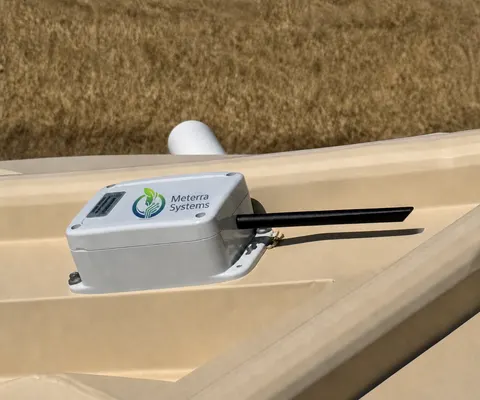
Plainly: no water level sensor sees algae. Ours does not, and nobody’s does. Algae is a visual and laboratory question, and it stays that way.
What level data gives you is the early read on the conditions that grow it. Algae is a stagnation problem, and stagnation shows up in a level chart as an absence of movement. A tank that has not drawn down all week is a tank sitting still in the heat, either because a float valve stuck full and it is topped off and motionless, or because the water got unpalatable enough that stock quit drinking it and went looking elsewhere. Both are visible on a trend line days before the green is visible from the truck.
That is the honest version of the pitch. A trough monitor will not clean your tank. It will tell you which tank stopped moving, which is usually the one about to go green, and it will confirm that the herd went back to drinking after you scrubbed it.
Tell us how many watering points you run and how far they sit from power and cell service, and we will map what it takes to see all of them from your phone.
The hardware this guide covers
Every device reports to the same Meterra dashboard and app.
Tell us what you need to keep an eye on and we'll map the right sensors and coverage.
Frequently asked questions
How often should I clean a water trough?
Extension guidance ranges from daily to twice a year, which sounds like chaos until you notice they are answering two different questions. The sources focused on algae say weekly or more in hot weather: Penn State suggests weekly or as-needed, and NC State goes as far as daily to twice weekly. The sources focused on sanitation say a full drain-and-disinfect once or twice a year, which is Alabama Extension's and UGA's advice. Do both. A quick brush-out weekly through summer keeps the green down, and a real scrub-out twice a year resets the tank.
How much bleach can I put in a stock tank, and how long before cattle drink?
This is where the published rates split. Several beef extension services land around 2 to 3 ounces of unscented household bleach per 50 gallons, weekly. UGA publishes a much lower rate, 8 ounces per 1,000 gallons, and states it produces about 3 ppm of chlorine, which it calls safe for cattle to drink. That is roughly five to eight times weaker than the first group. Hold times are just as inconsistent, from no withdrawal at all up to an hour. The sane approach is to start at the low end, mix it in well rather than leaving a concentrated slug, keep stock off for an hour, and use unscented bleach only.
Do goldfish actually control algae in a stock tank?
The research says no. University of Minnesota ran goldfish in horse stock tanks and measured the water, and the goldfish had no effect on chlorophyll or turbidity, which is to say no measurable effect on algae. The trial also saw a high death rate among the fish. Iowa State's own extension article acknowledges the finding. Goldfish do eat some organic matter and they are a pleasant tradition, but they also add waste to the tank, they die when the water gets too low, too hot, or freezes, and they do not replace cleaning.
Is copper sulfate safe in a livestock water tank?
For cattle, yes at label rates, though published rates vary about twofold, from roughly one ounce per 4,000 gallons up to one ounce per 8,000 gallons. Two hard cautions. Never use it where sheep drink, because sheep accumulate copper in the liver and are the species most prone to chronic copper toxicity. And if you are dealing with a blue-green algae bloom rather than ordinary green algae, an algaecide ruptures the cells and releases the toxin into the water: University of Kentucky guidance is to keep animals off that water for at least two weeks afterward. Copper sulfate is also corrosive to metal tanks, pipes, and float valves.
Can I use pool shock or chlorine tablets in a water trough?
We would not, and no extension service we found recommends it. The problem is dosing. A single large pool tablet is formulated to chlorinate thousands of gallons over several days, so dropping one in a stock tank is a large and slow-releasing overdose with no easy way to measure what the animals are actually drinking. Household unscented bleach at a published extension rate is the version somebody has actually put numbers to.
Is green water hurting my cattle, or does it just look bad?
Usually it is a palatability problem rather than a poisoning one. Ordinary green algae is not toxic, but it changes the taste and can cut water intake, and intake is the thing that drags on performance faster than any other nutrient shortfall. The exception that matters is blue-green algae, which is not algae at all but cyanobacteria, and which can kill cattle within a day. It looks different, more like spilled paint, pea-green water, or grains of green sand at the surface, and it is far more a pond problem than a trough problem.
Related Meterra pages
- Blue-Green Algae in Stock Ponds: the dangerous lookalike, and how to tell the difference.
- Catching a Stuck Float Valve Early: the failure that leaves a tank brim-full and stagnant for a week.
- Trough Level Monitor: watch the level, and the draw-down that tells you stock are drinking.
- How Much Water Do Cattle Drink Per Day?: the demand math behind sizing a tank that turns over.
- Livestock Water Monitoring: every watering point on one screen.