
Keeping a water trough from freezing without electricity
Every method on this list either adds heat or slows the loss, and almost nobody tells you which is which. So we worked out the numbers. An open four foot tank needs roughly 344 watts to avoid an inch of ice on a still night at 0F. Ground heat supplies about 37 to 74. Water turnover from a decent herd supplies about 400. A half gallon a minute of flowing water supplies about 950. That ranking is the whole guide, and it explains why the popular answers disappoint and the unglamorous one works.
There are only three ways to add heat without a wire
Wyoming Extension puts the principle in one line: all watering systems come down to supplying heat in some form to prevent freezing. Off grid, you have exactly three sources.
Sensible heat carried in by fresh water. Source water arrives at 45F or so and gives up its heat on the way down to 32F.
Conduction from the ground. The earth below the frost line sits well above freezing and leaks heat into anything buried in it.
Solar gain. Real, unmeasured in the livestock literature, and zero at night, which is when tanks freeze.
Everything else people recommend, insulation, covers, windbreaks, floating objects, is loss reduction. Loss reduction is valuable and we will get to how valuable, but it adds no joules. A tank with no heat input and perfect insulation still freezes. It just freezes later.
So the useful question is how many watts each method actually delivers. Here is our arithmetic, with the inputs, so you can check it.
| Source | Heat delivered | Basis |
|---|---|---|
| Ground conduction, buried 4 x 8 ft culvert | 37 to 74 W | soil k = 1.0 W/m·K, shape factor 7.37 m, 5 to 10 K difference |
| Herd turnover, 300 gal/day at 45F | about 397 W | 300 gal, 4,186 J/kg·K, 7.2 K drop, over 24 h |
| Continuous flow at 0.5 gpm (720 gal/day) | about 954 W | same method |
| 500 gal stored at 45F, cooling to 32F | 15.9 kWh, about 660 W for 24 h | one-time buffer, not a supply |
Against that, the loss side. An open four foot tank on a still night at 0F sheds roughly 344 watts, enough to form about three quarters of an inch of ice in eight hours. At 22 mph of wind that same tank sheds close to 900 watts and makes about three inches.
Two numbers fall out of this that reorder the usual advice.
Wind multiplies the convective loss by up to about 7.7 times going from calm to 22 mph. A windbreak is the highest leverage thing you can do that costs nothing, and it is usually mentioned last.
Shrinking the opening is worth about 23 times. A ten inch drinking hole is 4.3 percent of a four foot tank’s open surface. This is the entire design principle behind every insulated waterer, and Manitoba Agriculture states it plainly: with exposed water systems, the larger the open water area, the harder it becomes to keep ice free.
Continuous overflow: the strongest method, and the one with a real bill
At half a gallon a minute you are delivering roughly 954 watts, which is in the range of an electric de-icer, from a system with no electricity at it.
The best account of this in the literature comes from Dave Scott, a Montana producer writing for NCAT, who describes opening a hydrant full and setting the waterer valve so about half a gallon a minute runs out of a full tank. His setup was a 55 gallon barrel cut in half fed by 200 feet of three quarter inch black poly. He reported it holding frost free through wind chills in the 30 below range.
One operating rule from that account matters more than the rest, and it is the opposite of how the tank runs all summer: do not use a float in winter. The moment the float shuts the flow off, the heat supply stops and the system freezes. Flow is the heat.
Two caveats on that half gallon a minute, because it is the most quotable number here and it is not a design standard. It comes from one producer’s experience, and the 30 below figure is a wind chill rather than an air temperature. More importantly, the heat depends on how warm your water arrives, and that varies by where you live. USGS work going back to 1925 found groundwater temperature tracks the local mean annual air temperature, running a few degrees above it. A Montana spring therefore delivers materially less heat per gallon than a Missouri one, so the same flow rate is not the same heater. Every practice standard we read endorses trickle flow without ever specifying a rate. Set yours against your own water and your own weather.
Be honest about what it costs. At half a gallon a minute you are moving about 86,000 gallons across a 120 day winter. You will build an ice mound. You will make mud. Where that water goes has to be designed, not discovered: NRCS practice standards ask that overflow be directed to a stable outlet that does not cause erosion or wet conditions around the facility, and ideally back toward the source. NRCS Missouri’s grazing water systems guide is the only source we found that dimensions it: run the overflow to open outlets or to pits set 20 to 40 feet from the tank, dug 4 to 6 feet deep and filled with field rock or 2 to 3 inch gravel. Level the tank first, or it will run over at a corner and make the mud you were trying to avoid.
There is also a genuine conflict here worth flagging rather than hiding. The national NRCS standards for watering facilities and livestock pipelines both direct you to use a float valve to control flow and prevent overflow, because they are optimising for water conservation. Several state supplements, Colorado and West Virginia among them, explicitly allow continuous flow as a freeze control instead. If you are inside an NRCS-designed system, that trade is your state’s call, not a detail to improvise.
Energy-free waterers: they work, and they run on cattle
These are the units with insulated walls and floating balls or lids over small openings, fed from a below-frost supply line. They have a genuine cold-climate track record.
They are also animal-powered, and the marketing rarely says so. NDSU Extension is direct about it: these require a minimum number of animals drinking, or direct contact with the ground, to keep the water from freezing. The Beef Cattle Research Council notes that small herds may struggle to maintain adequate water cycling.
The one published threshold we could find is a volume, not a head count. Manitoba Agriculture says an insulated portable waterer should have enough cattle drinking that at least 300 gallons are consumed and replaced daily, and that if the water is not exchanged it cools and begins freezing at the drinking area. Divide that by a pregnant cow’s roughly 6.7 gallons a day at 40F and you are at 45 to 50 head. Our arithmetic, not theirs, but the inputs are both published.
Note what that means for the physics: at 25 head the turnover heat is around 199 watts, and at 10 head around 79 watts. The insulation has not changed. The heat source has.
And they are not ice free. Kentucky’s Master Grazer says geothermal systems are not ice free and typically need a thin layer cleared on very cold days. West Virginia Extension warns that if the animals are not using it, the floats can still freeze. The only cold-weather working limit we found published anywhere is a Saskatchewan Agriculture specialist noting that one pressurised geothermal system may need ice chipped below about 22 below zero, or if cattle have not drunk within 24 hours.
Ground heat and tire tanks: smaller than the name suggests
A buried culvert waterer is a good design. Manitoba’s version is a four foot by ten foot galvanised culvert set eight feet down, insulated, holding around 500 gallons, with cattle drinking from a tube at the top. It is well suited to long pipelines and it needs no power.
But run the numbers and the “geothermal” label oversells the mechanism. Ground conduction into that culvert is tens of watts. The tank stays open because the herd is pulling warm water through it and because the opening is small. The earth’s real contribution is keeping the supply line thawed, and Manitoba names the failure point precisely: where the supply line passes up through the frost line is the most likely place the system will freeze.
Tire tanks deserve the same honesty. A buried tire pit gets the same modest ground benefit and, per Manitoba, the float will still freeze into a layer of ice that needs clearing daily in cold weather. For a tire tank sitting on grade, the University of Kentucky’s tire tank publication (AEN-133, revised April 2024) is unambiguous: the water in tire tank waterers can freeze, and while the tire itself provides insulation, the surface of the water is exposed to air and wind. That publication makes no freeze resistance claim at all. If someone tells you tire tanks do not freeze, the land grant publication on tire tanks disagrees.
One safety item from the same source that has nothing to do with freezing and everything to do with not poisoning your herd: clean any tire thoroughly before use, because ethylene glycol or calcium chloride may have been used in it.
Propane: the only off-grid method that actually burns something
Asked how to keep a stock tank thawed at 7,400 feet on a solar well that could not support an electric heater, Colorado State’s beef production specialist answered that a propane stock tank heater is probably a best option. Saskatchewan Agriculture reports one keeping a three to five foot radius of water open. Nevada Extension describes a quarter inch copper tube propane bubbler built for about $90, with a tank lasting over a month.
The honest limit is not the burner, it is the fuel. Propane has to boil out of the cylinder to reach the regulator, and the colder and more humid it gets, the worse that goes. Frost on the tank wall acts as insulation and restricts heat transfer into the liquid, and the usable temperature difference driving vaporisation collapses at the low end. That is a silent failure: the heater does not break, the cylinder simply stops delivering. Keeping more fuel in the tank measurably helps, so a heater running on a nearly empty cylinder in a cold snap is the worst case.
Set the tank back where livestock cannot reach it and bury the supply line.
Solar: pump the water, do not heat it
This is not a close call, and it is worth putting numbers on because people keep trying it.
A 1,500 watt de-icer running half the time in December, at the winter sun hours NRCS publishes for the northern plains, needs somewhere around 9.4 kW of panel. Documented working solar livestock pumping systems run 128 to 420 watts of array. You are not sizing up a system, you are building a different one, roughly 22 to 73 times larger.
NRCS’s own practice in North Dakota tells you how this ends: those systems are shut down over winter and the storage tank drained, and it is common for the array to be installed seasonally for grazing and stored over winter. Their design examples size to October, not December.
The rule ATTRA states is the one to remember: storing water is almost always cheaper and simpler than storing electricity. Three to ten days of water storage beats a battery bank, and batteries lose badly in the cold anyway, running at around half their rated capacity at 25 below.
Where solar genuinely earns its place off grid is pumping, not heating, and there is one elegant freeze-beating design worth knowing: a motion-triggered pump that fills a small bowl only when an animal is present, then drains back below the frost line so no water sits exposed. Its failure mode is specific and worth writing on the lid, because it is a filter, not a pump: if the filter clogs, the bowl does not drain back, and the bowl and supply line freeze.
Insulation, covers and windbreaks: no heat, big multiplier
None of this adds a joule. All of it changes how far your joules go, and two of the levers are large.
Block the wind. Up to 7.7 times on the convective loss, by our calculation. Nothing else passive comes close for the money.
Shrink the opening. About 23 times, comparing a ten inch hole to an open four foot surface. Manitoba suggests a small roof with canvas drapes around the open water area, with some animal training, as a low cost way to do it.
West Virginia Extension has the most practical list of cheap methods we found: stack wool bags, straw bales or waste hay around the trough on the windward side; insulate the sides with used tires; cover half or more of the surface with plywood topped with foam or straw; or nest a smaller trough inside a larger one and pack the gap. Panel off part of the trough so only a small drinking area is exposed.
Keep the tank full. Stored water is a heat buffer. 500 gallons at 45F carries about 15.9 kWh on its way down to freezing, which is 660 watts for a day. A half empty tank has half the buffer.
Painting a tank black and siting it in the sun is recommended by several extension services. We will pass that along and also say plainly that we found no measurement of how much it helps. It is plausible, and it is unquantified.
The two remedies that do not survive arithmetic
Floating balls. An 8.5 inch ball covers about 3.1 percent of a four foot tank’s surface. Even treating it as a perfect insulator, that is 3 percent of the surface loss removed. You would need about 29 of them, hexagonally packed, to reach the 90 percent coverage where floating covers actually start suppressing losses. The agitation argument, that moving water freezes slower, is true and self-defeating: mixing the surface spends the tank’s stored heat faster, so it buys a longer ice-free window early at the price of a colder tank sooner.
That said, the ball has one genuine use, and it is mechanical rather than thermal. It leaves a weak spot livestock can push down to open a hole. Call it a hole-maker, not a heater, and it earns its place.
Jugs of salt water. This one runs backwards. A one gallon jug displaces about 3.79 kg of tank water. Had that water frozen, it would have released roughly 1,264 kJ of latent heat, which is heat that was actively defending the rest of the tank. In exchange, the brine stores about 72 kJ across a 5 degree swing, against the 79 kJ the same volume of water would have stored. It gives back slightly less than plain water and removes the latent heat entirely. Brine does not warm anything. It just declines to freeze itself, at the same temperature as everything around it.
No extension service tests salt jugs either way, so that is physics rather than a citation, and we would rather show the working than repeat the folklore.
Chopping ice is not a method, it is the bill
It is what every other method degrades into. Purdue notes it may need doing several times a day in extremely cold weather. Even heated bowls need checking several times daily in extreme cold.
The hazards are documented and worth stating. South Dakota State points out that breaking ice too close to the bank gets cattle agitating mud and hurting water quality, while breaking it too far out raises the risk of falls and injuries, and that once the ice is thick enough, livestock cannot break it themselves. On dugouts and ponds the Beef Cattle Research Council is blunter: there is a real risk of animals breaking through and drowning.
Snow is a legitimate partial substitute for a narrow set of animals. Research on dry pregnant beef cows found no difference in body mass, fat depth or calf weights against cows with free water access, corroborated by Ontario’s guidance and by Utah State, which reports cows eating 30 to 40 lb of snow a day. The conditions are strict: clean, loose, uncrusted snow, cattle in decent body condition, and a learning period of several days. Lactating cattle, newly weaned calves and thin cattle need real water. And for horses the advice reverses entirely, with Minnesota Extension advising against it on impaction colic grounds.
The part almost nobody mentions: re-watering can kill
If a herd has gone without water, the recovery is not simply turning the water back on.
During deprivation, brain cells generate osmoles to defend against rising serum sodium. When water comes back fast, serum sodium drops fast, water floods into those cells, and the result is cerebral edema that the Merck Veterinary Manual notes can be fatal even with treatment. Cattle, swine and poultry are the susceptible classes. The guidance for large animals is to limit intake to about 0.5 percent of body weight at hourly intervals until rehydrated.
The trigger is the deprivation, not salt in the diet. Which is the real argument for knowing your tank froze on the night it froze, rather than on your next trip out.
Two more things worth carrying: the standard water requirement tables floor at 40F, so any number you see for sub-freezing conditions is an extrapolation. And cold weather does not reduce need as much as people assume, because dry matter intake climbs as temperatures fall. On the published tables horses actually need more water in the cold, not less, because winter feed carries almost none of the moisture summer pasture did.
Where a monitor fits in an off-grid system
Every method above has the same failure signature, and it is the reason we build what we build. The herd stops turning the water over. The float ices in. The supply line freezes at the frost line. The propane cylinder stops vaporising. The filter clogs and the bowl will not drain back.
None of these announce themselves. They all look identical from the house, and they all show up first as a tank level that stopped behaving the way it did yesterday.
Two honest limits, stated once and not hedged throughout. Once a surface freezes over, an ultrasonic sensor reads the top of the ice, not the water underneath. And a level sensor does not measure water temperature, so it cannot warn you that a tank is heading for trouble, only that it has arrived.
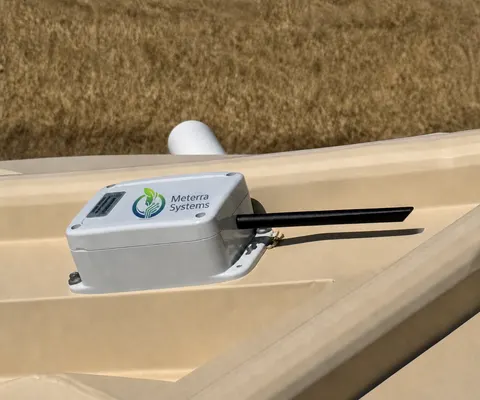
What it does do is tell you which of forty tanks to drive to at 6am on the coldest morning of the year, which is the decision that actually costs you. A Tank Level Sensor reads from above the water, so there is nothing submerged to freeze into ice and crack.
If the system is not winterized yet, start with when to winterize a livestock water system, because the dates are earlier than most people plan for.
The hardware this guide covers
Every device reports to the same Meterra dashboard and app.
Tell us what you need to keep an eye on and we'll map the right sensors and coverage.
Frequently asked questions
What is the best way to keep a stock tank from freezing without electricity?
Continuous low-rate flow, where you have the water to spare. A half gallon a minute of 45F source water carries roughly 950 watts of heat into the tank, which is comparable to an electric de-icer and more than any other passive method on the list. An NCAT researcher in Montana reported it holding through wind chills of 30 below. The costs are real and worth stating: about 86,000 gallons over a 120 day winter, plus an ice mound and mud you have to plan the drainage for.
Do energy-free waterers really work without any power?
Yes, in cold climates, but they are animal-powered rather than free. The heat comes from the fresh water the herd pulls through the tank, not from the insulation. Manitoba Agriculture's guidance is that an insulated portable waterer needs roughly 300 gallons a day consumed and replaced, or the water cools and the unit starts freezing at the drinking area. That works out to something like 45 to 50 head. A small herd on a big waterer is just a tank with a lid on it.
How much heat does the ground actually give a buried stock tank?
Less than people expect. For a 4 by 8 foot buried culvert with typical soil conductivity and a 5 to 10 degree difference between soil and water, the conduction works out to roughly 37 to 74 watts. An open four foot tank loses around 344 watts on a still 0F night. So ground heat is not what keeps a geothermal waterer open; animal traffic is. What the earth reliably does is keep the buried supply line thawed, which is where these systems usually freeze.
Does putting a ball in the water trough stop it freezing?
Not meaningfully, and it helps to know why. An 8.5 inch ball covers about 3 percent of a four foot tank's surface, so even as a perfect insulator it removes about 3 percent of the surface heat loss. You would need roughly 29 of them for the coverage at which floating covers start to matter. The agitation argument is real but self-limiting, because mixing the surface spends the tank's stored heat faster. The ball's genuine value is mechanical: it leaves a spot livestock can push down to open a drinking hole.
Do jugs of salt water keep a trough from freezing?
No, and the arithmetic runs the other way. A one gallon jug displaces about 3.79 kg of tank water. That displaced water would have released roughly 1,264 kJ of latent heat as it froze, heat that was defending the rest of the tank. The brine gives back nothing comparable, storing about 72 kJ over a 5 degree swing against water's 79. Net, the tank loses freeze resistance and gains none. No extension source tests this either way; that is physics, not a citation, and we would rather show the working than repeat the folklore.
Can cattle just eat snow instead of drinking?
For some classes, with real conditions attached. Research on dry pregnant beef cows found no difference in body weight, fat depth or calf weights against cows with free water, and Utah State reports cows eating 30 to 40 lb of snow a day. But the Beef Cattle Research Council is explicit that lactating cattle, newly weaned calves and thin cattle need another water source, and the snow has to be clean, loose and uncrusted. For horses the advice reverses: Minnesota Extension advises against relying on snow because of impaction colic risk.
Related Meterra pages
- When to Winterize a Livestock Water System: the dates and the drain-down order, before the cold arrives.
- Monitoring Stock Water Through Winter: what monitoring can and cannot see once a surface freezes.
- How Much Water Do Cattle Drink Per Day?: the demand tables behind the turnover math on this page.
- Stock Tank Monitoring: the far tanks, on the days the road is worst.
- Tank Level Sensor: reads from above the water, nothing submerged to freeze in.