
When to winterize a livestock water system
Most winterizing advice tells you what to do and skips the part you actually need, which is when. The answer is in the climate normals, and it is more useful than a calendar date: from the average first frost you have about ten days before a hard freeze and roughly four weeks before the temperatures that split pipe. That gap is your work order. Here are the dates, the sequence, and how to pull the numbers for your own place.
Start from your own freeze date, not a month
Every regional rule of thumb is wrong somewhere close to you. In Colorado, the median first 32F freeze at Alamosa is 15 September and at Grand Junction it is 16 October. That is 31 days apart inside one state, which is a wider spread than the difference between the Northern Plains and the Midwest.
So use station data. The table below is pulled from the NOAA/NCEI 1991-2020 US Climate Normals. Two columns matter. The 1-in-10 column is the date by which a first 32F freeze has a ten percent chance of having already happened, and it is the date to plan against. The median columns are the fifty percent dates, which is what most people mean by “average first frost.”
| Station | 32F, 1-in-10 | 32F, median | 28F, median |
|---|---|---|---|
| Bismarck, ND | Sep 15 | Sep 27 | Oct 5 |
| Glasgow, MT | Sep 17 | Sep 30 | Oct 9 |
| Rapid City, SD | Sep 16 | Oct 1 | Oct 9 |
| Missoula, MT | Sep 12 | Sep 26 | Oct 6 |
| Lander, WY | Sep 13 | Sep 27 | Oct 6 |
| Alamosa, CO | Sep 4 | Sep 15 | Sep 25 |
| Cheyenne, WY | Sep 18 | Oct 1 | Oct 11 |
| Denver, CO | Sep 27 | Oct 9 | Oct 18 |
| Grand Junction, CO | Oct 3 | Oct 16 | Oct 27 |
| Boise, ID | Oct 5 | Oct 21 | Oct 31 |
| Salt Lake City, UT | Oct 17 | Oct 31 | Nov 10 |
| Lincoln, NE | Sep 29 | Oct 13 | Oct 22 |
| Dodge City, KS | Oct 4 | Oct 20 | Oct 28 |
| Amarillo, TX | Oct 14 | Oct 27 | Nov 5 |
| Oklahoma City, OK | Oct 21 | Nov 2 | Nov 11 |
Pull your own station. NCEI serves every station as a plain CSV with no login at
https://www.ncei.noaa.gov/data/normals-annualseasonal/1991-2020/access/<STATION_ID>.csv.
The fields you want are named ann-tmin-prbfst-t32fp50 and ann-tmin-prbfst-t28fp50,
where the number after t is the temperature threshold and the number after p is the
probability. Six thresholds and nine probability levels are published, so you can read your
own risk tolerance straight off the file.
Two cautions before you trust any published table, including other people’s. Not every station has a full thirty years contributing, and the record length is in the file. And regional weather-service pages often use a different basis: one nearby office publishes on 1951-2022, another uses 32.6F instead of 32F, another calls 36F “frost.” Merging those into one table is the classic mistake.
The gap between frost and burst is your work order
This is the part almost nobody publishes, so we computed it from the same normals. Across the core stations above, the intervals are consistent enough to plan on:
- First 32F to first 28F: about 10 days (median). In the Plains and Mountain West the range is a tight 8 to 11 days. In the Southeast freezes arrive shallow and slow, and the gap stretches to 15 to 24 days.
- First 32F to first 24F: about 19 days (median, range 17 to 25).
- First 32F to first 20F: about 27 days (median, range 25 to 42).
- The 1-in-10 date to the median date: about 13 days (median, range 11 to 18). That is the margin you buy by planning early.
Those are our numbers, computed from the NOAA normals rather than quoted from an extension service, and you can reproduce them from the CSVs above. They matter because 20F is roughly where building research found uninsulated pipe in unconditioned space consistently began forming ice. Pipe in moving cold air can freeze warmer than that, so treat it as a planning threshold and not a floor.
Read together, the sequence is: the light-freeze jobs have no slack, and the hard-freeze jobs have about a month. Anything holding standing water in a thin-walled or above-ground component needs to be done before the first frost. Deeply buried line and anything with a committed heat source can wait for the second wave of work.
One thing we will not tell you, because we could not source it: that most freeze damage happens on the first unexpected freeze rather than mid-winter. It is repeated constantly in the trades and we found no government, academic or insurance-research source establishing it. The one land-grant statement we did find on timing puts peak freeze risk in late January and February. What the evidence does support is that unprepared regions take the worst losses when an out-of-pattern freeze arrives, which is a different claim and a better one.
The sequence, component by component
The federal standards are the cleanest checklist anyone publishes. NRCS Conservation Practice Standard 614, Watering Facility, lists the winter task in one sentence: draining supply pipes, emptying tanks, or ensuring that float valves will not be damaged by ice. Standard 516, Livestock Pipeline, requires complete removal of water from the pipeline by gravity or other means where freezing is a hazard.
Above-ground pipe and hoses. Before the first frost. Anything laid on the surface holds standing water in a thin wall. Ohio State and NRCS guidance is to drain exposed or surface-laid pipeline before freezing weather to avoid bursting. Hoses come off hydrants.
Yard hydrants. Before the first frost, and test them. A frost-free hydrant drains its riser through a bleed-off valve at the bottom of the hole, and the dominant failure mode is simple: partially closing the handle does not let it drain. Wyoming Extension’s hydrant guidance is worth reading in full, but three things carry most of the value. Set the hydrant on a rock or board rather than the bottom of the hole so water can get away. Give the bleed-off about ten gallons of clean medium gravel, covered with six inches of tamped dirt. And when you commission it, watch for water running out of the drain hole after you close it, before you backfill.
Buried lines. Depends entirely on your cover. Where the line sits below probable frost depth it can stay charged. Where it has only minimum cover, drains at the low points are required rather than optional, and that is language from the standard, not advice.
Do not blow the lines out with compressed air. Montana NRCS states directly that blowing water out of the pipeline with an air compressor is not allowed on its designed livestock pipelines. Anyone who winterizes a sprinkler system every fall will find that counterintuitive. The designed method is gravity drainage through valves or unions at the low points.
Float valves. Before the first frost, every time. This is the component that fails when the pipe survives. Missouri Extension makes the distinction plainly: freeze-resistant pipe can accommodate expansion, but float valves and connectors may not be freeze proof. NRCS names them specifically. If a valve stays in service through winter, direct the inlet along the side of the trough to keep the water circulating.
Tanks. Empty the ones going out of service and confirm the outlet pipe runs freely. Note that gravity systems freeze sooner than pressurized ones unless there is enough supply to keep water overflowing and moving.
Pumps and pressure tanks. On a submersible system the exposure is everything above ground. Iowa State puts it in one line: the pressure switch and pressure tank must not freeze, or the system fails. Surface and shallow well pumps have all their moving parts at the surface and need a pump house, held around 35 to 45F. At the wellhead, a pitless adapter is the standard freeze control, taking the connection below frost level.
While you are at the pressure tank, check it. Nebraska Extension gives the spec: precharge should sit about 2 psi below the pump cut-in pressure, so a 30 psi cut-in wants 28 psi in a drained tank. Open a hydrant and watch the cycle. The pump should run thirty to forty seconds and stop. Rapid cycling means a failed bladder, and a bladder that fails in November is a pressure tank that splits in January.
Nose and foot pumps do not winterize. They hold water in the drinking trough after stock finish, so they simply go out of service in freezing weather. Plan the winter water source, do not plan to protect these.
Solar pumping usually comes out rather than gets protected. The NRCS North Dakota technical note on solar stockwater design is blunt about it: in that climate the systems are shut down over winter and the storage tank drained, and it is common for the panel array to be installed seasonally for the grazing season and stored over winter. The reason is arithmetic, not caution. Usable sun runs six to seven hours a day in midsummer and two to three in October, so storage stops covering demand somewhere around November. If you are keeping a solar system running into the cold, the winter panel tilt is roughly your latitude plus 15 degrees, and fixed mounting beats a tracker anywhere that gets snow.
Frost depth: there is no national number
The national NRCS pipeline standard sets no numeric burial depth at all. It requires only that pipe go deep enough to protect it from traffic, farming operations and freezing. The numbers come from state supplements and local code.
Published values give a sense of the range: about 15 inches in southeastern Missouri and up to 40 inches at the Iowa line, 30 to 36 inches in Ohio, 45 to 60 inches across much of Wyoming, and a 5 foot minimum in Montana NRCS designs, which also require 5 feet of cover on any pipeline intended for winter use.
The adjustment people miss is the one that catches them out. Missouri Extension notes that wet, compacted soil with no snow cover can freeze about two feet deeper than the published depths. Pond edges and river bottoms hold moisture year round and freeze deeper for the same reason. Snow is insulation, and the winter that strips it is the winter that finds your shallow line.
Get the number from your county building department or your NRCS field office. A national frost map is the wrong tool.
Heaters, cords, and the honest limits
If a tank stays in service, the electrical side becomes the risk. Heat tapes, heated waterers and tank heaters must have a thermostat and be UL listed, per Rutgers Extension. SDSU Extension makes the case for daily checks on both animal-care and fire-prevention grounds, because a heater energised in a tank that has run dry is a fire risk. Floating heaters want wire guards around the element. Inspect cords for wear, missing grounding prongs and corrosion, and run temporary wiring through conduit where livestock or rodents can reach it. If the tank depends on electric heat, plan the backup power before you need it.
On stray voltage, the honest position is narrower than the internet’s. Controlled experiments applying voltage directly to a drinking bowl do show refusal: heifers drank about 20 percent less at 3 volts and 68 percent less at 6 volts in one study, and a group of 30 refused to drink for eight hours at 8 volts. But those effects faded within a couple of days as the animals adapted, and at the levels actually found on working farms the picture changes again. Wisconsin regulators surveyed over 6,000 first-time investigations and found 91.8 percent measured one volt or less at cow contact. Trials running a full lactation at 1, 2 and 4 volts found no significant difference in water consumption.
That same Wisconsin work settles a question worth being straight about, because it cuts against our own product. Half the farmers who called in cited reduced water intake as the symptom. Metered investigations found actual intake of 20.1 gallons per cow per day against a predicted need of 20.4, and concluded that a water meter is not a useful field tool for predicting cow contact current. If you suspect stray voltage, you need a meter built for it, not a water sensor.
What to put a monitor on before the cold
Winterizing is a day of work that either held or did not, and you usually find out at the worst moment. The tanks worth watching are the ones you stop being able to check: the far pasture, the far side of a drift, the one at the end of the road that closes.
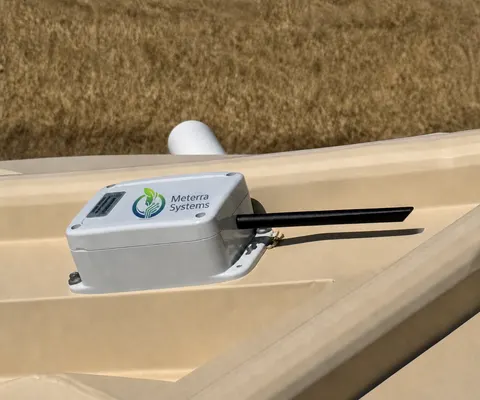
What a level sensor honestly gives you here is early evidence that something upstream quit. A stuck float, a line that stopped filling, a heater that failed and let the tank cap over, a pump that stopped: they all look the same from the house, and they all show up as a level that stopped behaving. A Tank Level Sensor reads from above the water, so there is no submerged probe to freeze into ice and crack.
Two limits, stated once. Once a surface freezes over, an ultrasonic sensor measures the top of the ice rather than the water underneath, so it will not track level through a hard freeze. And it does not read water temperature. Pair it with the heater rather than instead of it, and it tells you the moment the heater stops keeping up.
Set the alerts while the ground is still soft and you are still standing at the tank. That is the cheapest hour in the whole job, and it is the one everybody puts off until the first storm makes it urgent. For what to do once winter is actually running, monitoring stock water through winter picks up where this leaves off.
The hardware this guide covers
Every device reports to the same Meterra dashboard and app.
Tell us what you need to keep an eye on and we'll map the right sensors and coverage.
Frequently asked questions
When should I start winterizing a livestock water system?
Work back from your own first-freeze date rather than a calendar month. In the NOAA 1991-2020 climate normals, the date with a one-in-ten chance of a first 32F freeze runs about 13 days ahead of the median date at most stations. Planning to that earlier date costs you very little and is wrong about one year in ten. Texas A and M AgriLife Extension frames the season as preparing in October and November and maintaining through March or April, but the station data is more precise than any regional month.
How long after the first frost until pipes are at risk of bursting?
Computed from the 1991-2020 normals, the median gap between the first 32F freeze and the first 20F reading is about 27 days, and the gap to the first 28F reading is about 10 days. That is the practical sequence: anything holding standing water above ground has no slack at all, while deep-freeze work has roughly a month. Around 20F is where building research found uninsulated pipe in unconditioned space consistently began forming ice, though pipe exposed to moving cold air can freeze warmer than that.
How deep do I need to bury a livestock water line?
There is no national number, and that is the important part. The federal NRCS pipeline standard requires only that pipe be deep enough to protect it from traffic, farming operations and freezing, and leaves the depth to state supplements and local code. Published values range from about 15 inches in southern Missouri to 5 feet in Montana NRCS designs for winter-use pipelines. Get your local frost depth from the county building department or your NRCS field office, and note that wet compacted soil with no snow cover can freeze about two feet deeper than published depths.
Can I blow out livestock water lines with compressed air?
Not on an NRCS-designed livestock pipeline. The Montana NRCS pipeline standard states plainly that blowing water out of the pipeline with an air compressor is not allowed, which surprises people who winterize irrigation that way every year. The designed method is gravity drainage through valves or unions installed at the low points, and where a line has only the minimum cover, those drains are required rather than optional.
Why did my frost-free hydrant freeze?
The usual reason is that it was not shut all the way. A frost-free hydrant drains its riser through a bleed-off valve at the bottom of the hole when the handle is fully closed, and partially closing the handle stops that drainage and leaves a column of water above the frost line. The other common causes are a drain pit that was never given its gravel, or a hydrant set on the bottom of the hole with nowhere for the water to go.
Will a water monitor tell me my tank heater has failed?
It tells you the level stopped moving or the tank stopped refilling, which is what a failed heater, a frozen line or a quit pump all look like from a distance. That is worth having on a tank you cannot see. Be clear about what it is not: a level sensor does not measure water temperature, does not detect ice on the surface, and does not detect stray voltage. Wisconsin regulators tested that last one directly and concluded a water meter is not a useful field tool for finding cow contact current.
Related Meterra pages
- Monitoring Stock Water Through Winter: what happens after the system is winterized and the cold sets in.
- Catching a Stuck Float Valve Early: the component NRCS names specifically in its winter checklist.
- Stock Tank Monitoring: the tanks you cannot check daily once the roads turn.
- Knowing When a Well Pump Stops: the failure that empties a tank fastest in a cold snap.
- Tank Level Sensor: non-contact, so there is no submerged probe to freeze into ice.