Pond Losing Water: Leak or Evaporation? How to Tell
The fastest tell is the overnight. Evaporation does its work in hot daylight hours and nearly stops after dark — a leak drains around the clock at close to the same rate. A 24-hour bucket test gives you a quick answer, and a week of logged water level gives you a confident one. In hot, dry summer weather, a quarter to a half inch of drop per day can be nothing but evaporation.
A dropping pond in July doesn’t automatically mean a leak. In hot, dry, breezy weather, Clemson Extension puts normal evaporation at roughly a quarter to a half inch of surface drop per day — call it an inch and three-quarters to three and a half inches over a week, from sun and wind alone. That’s a lot of water to lose honestly. So before you price bentonite by the ton, figure out which problem you actually have. There are two good ways: a bucket and a day, or a sensor and a week.
The 24-hour bucket test: do this first
Extension offices have recommended versions of this test for decades, and it works. The idea is simple: a bucket of pond water sitting in the pond evaporates at the same rate as the pond, but it can’t leak. So any difference between the two is your leak.
- Fill a bucket with pond water to an inch or two below the rim.
- Set it on a step, shelf, or brick in the shallows so a few inches of the bucket sit below pond level — same sun, same wind as the pond surface.
- Mark the water level inside the bucket with a permanent marker.
- Mark the pond’s level on the outside of the bucket.
- Come back in 24 to 48 hours — no pumping, no filling in between.
If both levels dropped about the same, you’re looking at evaporation. If the pond fell noticeably faster than the bucket, water is going somewhere besides the sky.
The test’s weakness is its length. One calm day and one windy day give different answers. A thunderstorm ruins the run. And a slow leak — the kind that costs you a foot a month — can hide inside the marker-line slop of a single day. That’s where logging earns its keep.
What a week of level data shows that one day can’t
Evaporation and leaks have different daily shapes, and a continuous level record makes the difference visible.
Evaporation is a daytime process. It concentrates in hot afternoons, picks up with wind and low humidity, and slows way down overnight when the air cools and the sun is gone. On a level chart, that draws a stair-step: a sag through each afternoon, then a nearly flat shelf through each night.
A leak doesn’t care what time it is. Water moving out through a rusted outlet pipe, a muskrat run, or a gravel seam under the pond drains at a near-constant rate around the clock. On the chart, that’s a steady ramp — and critically, the line keeps falling through the night.
So the question a week of data answers is the one the bucket can’t: what does your pond do between midnight and dawn? Flat overnight shelves point to evaporation. A line that falls all night, every night, at about the same rate as the afternoon, points to a leak. A mix — steep afternoons plus a modest but steady overnight fall — tells you you have some of both, and the overnight rate tells you roughly how big the leak’s share is.
A worked example. Say your pond dropped three inches over a hot week in a drought summer. At a quarter to a half inch a day of evaporation, three inches in seven days is entirely explainable by weather — if the overnight line is flat. The same three inches in a mild, overcast week, or three inches where the level keeps sliding through every night, is a different story. Same total; opposite conclusions. That’s why the number alone can’t settle it, and the shape can.
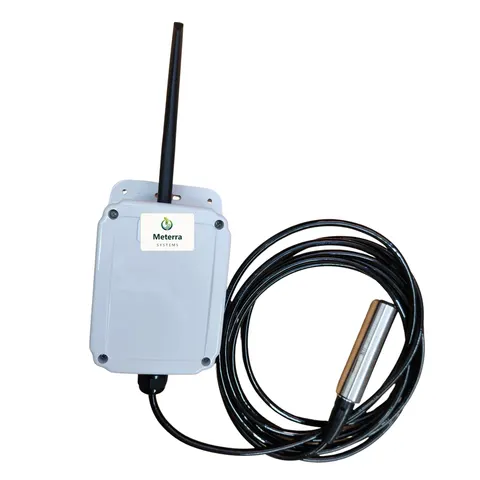
This is exactly what a Dam & Pond Level Monitor is built for: a submerged pressure sensor reads true water depth continuously and reports over NB-IoT cellular — LTE or low-orbit satellite where cellular is thin — with no power or Wi-Fi at the pond. It starts at $499 with the first 3 months of connectivity and the dashboard included, and because the sensing element sits in the water rather than above it, it keeps reading through winter ice, when a surface sensor only sees the top of the ice. The same setup handles bigger water too — see pond and dam monitoring for how it’s used on reservoirs and irrigation storage.
Put rainfall on the same chart
One more thing a single test can’t do: account for rain. A wet week can mask a leak completely — the pond takes on two inches of runoff, loses two and a half to the leak, and the casual glance says “about the same as last Sunday.” Meanwhile the leak got a week older.
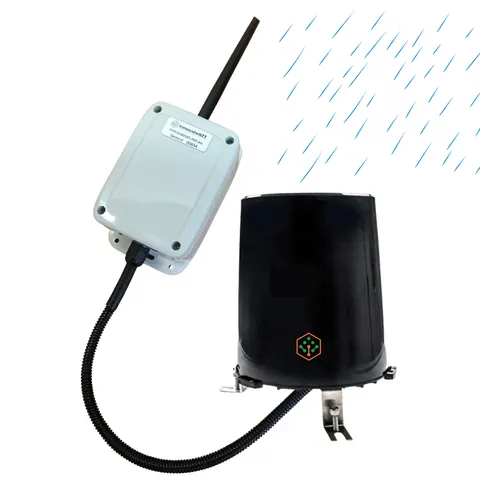
A rain gauge on the same dashboard closes that hole. When rainfall and pond level share a chart, you can see whether a bump in level matches the storm that should explain it — and whether the level resumes its overnight slide the moment the runoff stops. If you’re comparing conditions across pastures, the same gauges track rainfall across properties so you know which pond caught which storm.
When it’s just evaporation, and you can stop worrying
Plenty of “leaking” ponds are healthy ponds in a hot month. Penn State Extension notes that evaporation and plant water uptake together rarely exceed about 12 inches even during the driest month. If your losses are inside the normal daily range, slow down in cool or humid weather, nearly stop overnight, and stay under that monthly ceiling — that’s weather, not a defect. Watch the trend, plan your storage for dry years, and put the bentonite money back in your pocket.
If losses run past that, or the overnight line won’t flatten, it’s time to hunt.
The honest limit: a sensor finds that, not where
Level data tells you the pond is leaking, how fast, and when it started getting worse. It will not tell you where the hole is. Finding it is still boots-and-shovel work: inspect the outlet and drain pipe (old corrugated pipe rusts through), walk the dam for wet spots, soft ground, or a suspiciously green strip below it, and look for burrows and tree roots on the banks. Bottom seepage into sand, gravel, or fractured rock usually shows nothing on the surface at all.
And fixing it is dirt work, not electronics — compaction, clay, bentonite, or a liner, matched to your soils. That’s a conversation for your local NRCS office before it’s a purchase; they can characterize what’s under your pond and point you at the federal pond standard. The same overnight-slope reasoning applies to pressurized systems, by the way — if the suspect is a pipeline rather than a pond, see finding water leaks with flow data.
We’ve had sensors in the field for over four years — 2,000+ devices, from stock ponds to a municipal tank in Huntsville, Utah — and every one carries a 60-day money-back guarantee and a 1-year warranty. Tell us your setup — pond size, dam type, how far it sits from cell coverage — and we’ll map the right sensors for it.
The hardware this guide covers
Every device reports to the same Meterra dashboard and app.
Tell us what you need to keep an eye on and we'll map the right sensors and coverage.
Frequently asked questions
How much pond evaporation is normal in summer?
In hot, dry summer weather, extension guidance puts normal evaporation at roughly a quarter to a half inch of surface drop per day, and Penn State Extension notes that evaporation plus plant water uptake rarely exceeds about 12 inches even in the driest month. If your pond is dropping faster than that with no outflow running, suspect a leak. Cooler, humid, or overcast stretches should slow the drop noticeably — if they don't, that is another leak sign.
Where do farm ponds usually leak?
The usual suspects are the outlet or drain pipe (older pipes rust through), the dam and banks (tree roots and animal burrows open channels), and a pond bottom that was never compacted well — especially over sand, gravel, or fractured rock. Leaks at the pipe or dam often show up as a wet spot or green strip below the dam. Bottom seepage usually has no surface tell at all, which is why level data matters.
Does pond sealer like bentonite actually work?
It can, when the problem is a permeable bottom and the material is applied right. Penn State Extension describes working bentonite into the bottom at about one pound per square foot, or recompacting and adding clay in thick layers. What sealants can't fix is a rusted-out pipe or a burrow through the dam — the fix has to match where the water is actually going.
When should I involve NRCS about a leaking pond?
Before you spend money on dirt work. Your local NRCS office can help characterize the soils under your pond, point you to the federal pond design standard (Agriculture Handbook 590), and tell you whether compaction, clay, bentonite, or a liner fits your site. If the dam itself is involved, get professional eyes on it — dam repairs are not a guess-and-check job.
Can a water level sensor tell me where the leak is?
No — and be wary of anyone who says otherwise. A logged level line tells you that the pond is losing water, how fast, and whether the loss runs through the night like a leak or tracks the daytime heat like evaporation. Finding the actual hole still takes eyes on the outlet pipe, the dam face, and the banks, and fixing it is excavator work, not electronics.
Related Meterra pages
- Pond & Dam Monitoring: continuous level logging for ponds, dams, and reservoirs.
- Dam & Pond Level Monitor: the submerged pressure sensor this guide describes.
- Rain Gauge: put rainfall on the same chart as your pond level.
- Finding Water Leaks with Flow Data: the same overnight logic, applied to pipelines.
- Stock Pond Drying Up? Calculating Days of Water Left: turning a falling level into days of water remaining.