
What Does Remote Water Monitoring Cost?
Here is the whole bill, in writing: $299 Tank Level Sensor, $399 Trough Level Monitor, Dam Level Monitor from $499, each including three months of connectivity, then plans from $10/month per device. Remote water monitoring is priced per monitored point, a sensor for each tank, trough, or dam, so multiply by your points and you have your total before you talk to anyone. Against the fuel, hours, and dry-tank losses of checking by truck, one sensor often pays for itself in a season, and a 60-day money-back guarantee means you can prove that on your own tank first.
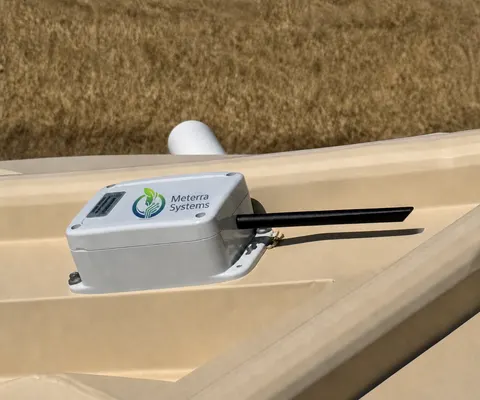
How remote water monitoring is priced
Almost every system is priced the same way: per monitored point. You buy a sensor for each tank, trough, or dam you want to watch, and you pay a connectivity subscription for the data to reach your phone. The total scales with how many sites you have.
That’s the industry’s formula. Here is Meterra’s side of it, posted in full:
- Hardware. $299 Tank Level Sensor, $399 Trough Level Monitor, Dam Level Monitor from $499. Each price includes the first three months of connectivity and full dashboard and app access. Sensors ship from US stock, tank sensors within 1 to 2 business days (July 2026).
- Connectivity. Meterra runs on Verizon’s low-power NB-IoT network, which keeps the plan cheap: from $10/month per device after the bundled period, with discounts on annual subscriptions. Satellite is added where a site needs it, at higher cost, and only there.
- Points. The multiplier. Start with one, add as you go.
What you don’t pay for is installation. Meterra sensors mount yourself in minutes, no electrician, no trenching, no contractor bill on top.
The per-tank math
Because every number above is posted, you can run the whole bill right now:
- One tank, year one: $299 hardware, which covers months one through three of connectivity, then nine months at the $10 plan. $389 total, about a dollar a day.
- One tank, every year after: $120 at the $10 plan. About 33 cents a day to never drive out and guess.
- A mixed setup, say three tanks, a trough, and a dam: $897 + $399 + $499 = $1,795 in hardware (the dam at its $499 starting price), then from $50/month across all five points once the bundled months run out.
No quote call produced those numbers. This page did, and that’s the point.
What that number replaces
The price only makes sense next to what checking water the old way costs, and that cost hides in fuel, hours, and truck wear:
- University extension estimates put the fuel alone for driving to check remote water at well over $1,500 a year on larger operations.
- That’s before your time, the tires, and the one expensive day a tank is empty and nobody knew.
Put your own miles and trips into the water savings calculator and the monitoring usually pays for itself well inside a season. See how to cut water-hauling trips for where the savings actually come from.
Hold any quote against this page
Before you spend a dollar with anyone, get the whole bill in writing: hardware plus the monthly service, per point, for every point you’ll watch. Ours is already in writing, right here: $299 tank, $399 trough, from $499 dam, three months of connectivity in the box, then from $10/month per device. No quote call, no sales sequence. Plenty of vendors in this category price by quote instead, and a vendor who’s proud of the total posts it. So ask them for their two columns, put them next to ours, and run the math. If their total genuinely comes back better for your sites, buy theirs. We’re comfortable saying that in public, next to our posted prices, and notice which vendors are comfortable saying it next to theirs.
How to keep the cost down
- Start with one point. Put a sensor on your worst tank, prove the value, then expand. You don’t have to wire the whole place at once.
- Right-size the connectivity. NB-IoT where it reaches (most places), satellite only where a site truly needs it.
- Buy without the risk. Every sensor carries a 60-day money-back guarantee and a one-year warranty. Put one on your own operation, and if two months of readings don’t make the case, send it back for a full refund.
Get your number tonight
The prices are on this page and the arithmetic is yours to run: put your tank count and miles into the savings calculator for the payback, or go straight to the products and start with the $299 sensor on your worst tank. Tell us your sites and we’ll size the whole setup the same business day.
The hardware this guide covers
Every device reports to the same Meterra dashboard and app.
Tell us what you need to keep an eye on and we'll map the right sensors and coverage.
Frequently asked questions
How much does remote water monitoring cost?
With Meterra, the whole bill is posted. $299 for the Tank Level Sensor, $399 for the Trough Level Monitor, from $499 for the Dam Level Monitor, each including three months of connectivity and full dashboard and app access. After that, plans run from $10/month per device, with discounts on annual subscriptions. One tank in year one comes to $389 at the $10 plan, then $120 a year after. Multiply by your points and you have the number most vendors make you book a call to get. Tell us how many points you watch and we'll size the whole setup the same business day.
What makes up the cost?
Three things. The sensor hardware at each point, the connectivity plan that carries the data, and how many points you monitor. Install is do-it-yourself, no electrician and no trenching, so there is no contractor bill on top. Meterra posts the first two numbers openly, which leaves your point count as the only variable.
Is it worth it?
For most operations, yes, because the cost it offsets is real. University extension figures put the fuel alone for checking remote water at well over $1,500 a year on larger operations, before hours, truck wear, or a single dry-tank loss. Against a $299 sensor and $120 a year in connectivity, that math is not close. Our savings calculator turns your own miles and trips into a yearly number.
Can I start cheap with one sensor?
Yes, and that is how most operations start. Put a $299 Tank Level Sensor on your worst tank, the longest drive or the one that has surprised you before, and let it make the case. Every sensor is backed by a 60-day money-back guarantee and a one-year warranty, so if two months of readings don't earn the next sensor, send the first one back for a full refund.
Does connectivity add a lot?
No. Meterra runs on Verizon's low-power NB-IoT network, which keeps plans from $10/month per device after the three months bundled with each sensor, with discounts on annual subscriptions. Satellite is available where a site truly has no cell coverage, at higher cost, and we match the connection to your coverage so you only pay for it where it's needed.
Related Meterra pages
- Water Savings Calculator: turn your miles and trips into a yearly cost and a savings estimate.
- What Does RanchBot Cost?: comparing against RanchBot? What their site does and doesn't say about price.
- Meterra vs. RanchBot: the full feature-by-feature comparison.
- How to Cut Water-Hauling Trips and Costs: where the savings actually come from.
- Meterra Product Range: the two sensors we lead with, and what's coming.
- Tank Level Sensor: the workhorse sensor most operations start with.
- How to Choose a Remote Water Monitoring System: the questions that separate a good fit from a poor one.
- Water Tank Monitoring: the $299 tank sensor in its most common job.
- Livestock Water Monitoring: which sensor suits a tank, a trough, or a dam on a ranch.