Weaned calves not drinking: what the first days actually look like
A newly weaned calf standing in a strange pen next to a waterer it has never seen is not being stubborn. In a 2026 feedlot trial, heifers whose only water source was an automatic waterer drank about a gallon a head per day across their first four days, roughly a sixth of what a calf that size normally drinks. Adding one open stock tank nearly tripled it. Here is what the research actually supports, what it does not, and the one question about the first 72 hours that nobody has published a good answer to.

The number worth knowing before weaning day
A trial published in the Journal of Animal Science in 2026 followed 270 newly received crossbred heifers averaging about 520 lb, split across eighteen pens. The control pens had what most weaning pens have: an in-pen automatic waterer, working correctly, water available at all times.
Across days 1 to 4, those heifers drank 4.16 litres a head per day, about 1.1 gallons.
For context, the reference tables that Nebraska Extension and NDSU both publish put an animal that size somewhere around 6 to 7 gallons a day at moderate temperatures. The control calves drank roughly a sixth of it.
The pens that got one extra 416-litre open stock tank drank 11.8 litres a head per day, about 3.1 gallons, nearly triple the control figure, at P less than 0.001. A third group offered a mineral drinking solution in the same open tank drank 17.6 litres. The supplemental sources were only there for four days, then removed. Smithyman et al., Journal of Animal Science vol. 104, 2026.
Two honest notes on that finding, because they change how you should use it. First, the authors do not attribute the low control intake to calves failing to find the waterer. They do not discuss waterer naivety at all, and transit stress, diet transition and competition at a single drinker are all consistent with the same result. Second, the deficit did not last: those same control calves averaged 10.9 litres a day across the full 56 days. This is an acute problem, not a chronic one.
What makes it worth acting on is that the early gap still cost something downstream. Feed intake from days 5 to 15 was 7.30 kg a head per day in the control pens against 8.32 kg in the pens that had been given the open tank, and that advantage held through day 29. Four days of better water access showed up in feed intake a month later.
Why a calf may not use the waterer in front of it
The mechanism most often cited by extension is the simplest one. Nebraska Extension’s guidance on starting newly weaned calves states plainly that calves which have only drunk from ponds or pasture tanks will not recognize automatic or ball waterers. Utah State Extension arrives at the same conclusion independently, noting that if calves have never used a commercial water tank they may not recognize it as a water source.
Two land-grant institutions saying the same thing from different data is about as good as this kind of guidance gets. Be careful about the folklore that has grown up around it, though. The idea that calves learn where water is by following their dam is widely repeated and, as far as we can find, not established in the literature. The nearest relevant research concerns social facilitation, the fact that an animal is more likely to investigate something it sees others using, and that is a different and weaker claim than calves being taught to drink.
The practical upshot does not change. Do not assume recognition. Make the water obvious.
What to do, in order of how well it is supported
Overflow the tank, or run a hose into it. This is the best-supported single recommendation on the list, because Utah State and Nebraska recommend it separately. Moving, audible, visible water is the thing a calf recognises. Let it run over.
Put an open tank or tub in the pen even if the pen already has a waterer. This is exactly what the 2026 trial tested, and it is the only technique here with a controlled intake number attached to it. An automatic waterer is not a substitute for an open surface of water in the first few days.
Keep the trough small rather than large. Alabama Extension’s preconditioning guidance recommends troughs that are clean, highly visible, and accessible, and makes the case for smaller troughs on the grounds that calves can hear them refilling and the water turns over faster and stays cooler. Treat the sound argument as design rationale rather than a tested finding, but the turnover argument stands on its own.
Watch the water temperature. Auburn’s extension guidance puts the preferred range at 40 to 65F, with intake dropping above 80F, and the University of Tennessee independently reports the same 80F threshold. A black tub in full September sun in the Intermountain West clears 80F easily. Shade the tank.
Place tanks where a calf walking the fence will meet them. This one is worth doing and worth labelling honestly: it is a widely repeated management rule of thumb, and we could not find it tested in extension or peer-reviewed work. It costs nothing to follow.
Check the water before you blame the calves
A calf that reaches the tank and turns away is telling you something different. Nebraska Extension’s peer-reviewed water quality guide, NebGuide G2060, gives the thresholds that matter, and one of them is specific to this class of animal:
- Total dissolved solids up to 3,000 ppm is usually satisfactory. Around 5,000 ppm costs roughly 10 percent of performance.
- Sulfate has a recommended upper limit of under 500 ppm for calves, against under 1,000 ppm for mature cattle. Calves are the sensitive class, and a water source the cows have drunk for years without trouble is not automatically fine for the weanlings.
- Nitrate nitrogen under 10 ppm is safe, 41 to 100 ppm puts cattle at risk, and over 101 ppm is unsafe.
- Off flavours from sulfates, hydrogen sulfide, iron, magnesium and extreme pH all suppress intake without making the water dangerous.
Late summer adds one more. Blue-green algae blooms concentrate on the downwind side of a pond and peak, as the same guide notes, exactly when consumption is highest. If the weaning pen draws off a pond, know what you are looking at.
The question nobody has published a good answer to
Here is the gap. Every piece of extension guidance we found tells you to check that the water is available: clean, flowing, checked at least daily. Utah State recommends observing cattle at least twice a day for the first 45 days after weaning. None of it tells you how to confirm that the calves have actually drunk.
That absence is real, and it is worth stating carefully. We could not find published guidance on confirming intake, which is not the same as saying no method exists. What producers do in practice is drive out and look at the tank.
The research that does measure intake gets there with instrumented equipment. The 2026 feedlot trial recorded pen-level intake. The Italian study that found intake falling about two days ahead of respiratory treatment used RFID drinking stations with flow sensors on individual animals (Magrin et al., Preventive Veterinary Medicine 247, 2026). Neither used a tank level sensor, and we are not going to pretend otherwise.
That second study is worth citing for one more reason. It is a useful corrective to the common claim that respiratory disease peaks in the first two weeks. In a dataset of 102,811 US feedlot cattle across 25 yards, the 25th percentile of first treatment fell between day 12 and day 19 depending on season and sex, meaning most first treatments happen after the two-week mark. The first days are when the intake deficit is established. The illness usually shows up later, which is precisely why an early signal is worth having.
What a tank monitor honestly gives you
Scoped correctly, level data on the weaning pen tank answers three questions, and it is worth being clear about which three.
Is the group drawing water at all, and how much? A level trace gives total draw on that tank and the shape of it through the day. In the 2026 trial the difference between the control pens and the open-tank pens was not only volume but timing: control calves took 65 percent of an already tiny intake in one morning window and drew 0.568 litres overnight, while calves with an accessible open tank shifted 47 percent of their drinking to overnight. Draw and its daily shape both moved with water access, and both are visible in a level trace.
Is the water actually getting there? A stuck float, a pump that quit, a line that stopped filling. These are the failures that leave you looking at a full tank and concluding the calves are not thirsty. It is the least glamorous thing a monitor does and the most reliably useful.
What it will not do is tell you which calves drank. A tank reading is a group number. It cannot separate thirty calves drinking a little from ten drinking a lot, and anyone selling you per-animal insight from a tank level reading is selling you something the physics does not support.
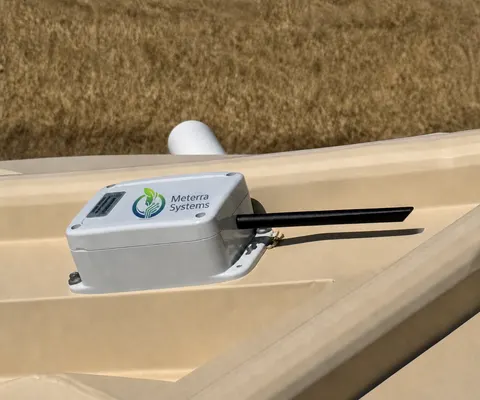
That is a real limit, and it still leaves the thing worth having. On weaning day the question is whether the water in that pen is being used or merely present, and a drive past the tank answers that once a day at best. A Trough Level Monitor answers it every hour, from the house, on the days when the answer changes fastest.
Set the low-level alert before you wean, not after. The first four days are the ones that show up in feed intake a month later, and they are the days you are least able to spare for driving out to look at a tank.
The hardware this guide covers
Every device reports to the same Meterra dashboard and app.
Tell us what you need to keep an eye on and we'll map the right sensors and coverage.
Frequently asked questions
How much water should a weaned calf drink per day?
Extension reference tables from the University of Nebraska and NDSU, both drawn from NRC figures, put a 400 lb growing animal at about 5.8 gallons a day at 70F and a 600 lb animal at about 7.8 gallons, rising sharply in heat to 9.5 and 12.7 gallons at 90F. Read those as observed intake for settled cattle that know where the water is, not as a target for a calf on its first day. Both publications describe them as approximate total daily intake, and the underlying data goes back to a 1956 paper carried forward through NRC 2016.
Why will my weaned calves not drink from the trough?
The most commonly cited reason in extension guidance is simply that they have never seen that kind of waterer. Nebraska Extension notes that calves which have only drunk from ponds or pasture tanks will not recognize automatic or ball waterers, and Utah State Extension says the same thing independently. Water quality and temperature are the other two candidates worth checking before you assume it is behaviour: cattle reduce intake in water above 80F, and calves are more sensitive to sulfates than mature cattle are.
Does low water intake cause respiratory disease in weaned calves?
A link has been measured, but causation has not been established, and the difference matters. In a 2026 Italian study of 92 cattle with individually metered drinkers, water intake fell significantly about two days before animals were treated for respiratory disease, and intake below a threshold carried roughly four times the odds of developing it. In the 2026 feedlot trial, pens given an extra open water source tended to have lower respiratory disease incidence, but that result sat at P of 0.10 or less and the overall difference in cattle treated was not statistically significant. Treat falling intake as a useful early signal, not as a proven cause.
How long does it take weaned calves to drink normally?
In the 2026 trial the deficit was acute rather than chronic. Calves on the automatic waterer alone averaged about 4.2 litres a head per day over days 1 to 4, but averaged 10.9 litres across the full 56 days. The gap closes on its own. What the same study showed is that the early gap still cost something: pens with the extra water source ate measurably more feed through day 29.
Can a water level sensor tell me whether my calves are drinking?
It tells you what the group drew, not what any individual calf drank, and that distinction matters. A level trace cannot separate thirty calves drinking a little from ten drinking a lot. What it does show honestly is the total draw on that tank and the shape of it through the day, which is the difference between a tank that is being used and one that is merely full. It also catches the failures underneath the question, a stuck float, a quit pump, an empty line, which are worth catching on their own.
What water quality problems stop calves drinking?
Nebraska Extension's water quality guidance puts total dissolved solids up to 3,000 ppm as usually satisfactory, with about a 10 percent reduction in performance around 5,000 ppm. Sulfate is the one where calves differ from mature cattle: the recommended upper limit is under 500 ppm for calves against under 1,000 ppm for adults. Nitrate nitrogen under 10 ppm is considered safe, 41 to 100 ppm puts cattle at risk, and above 101 ppm is unsafe. Off flavours from sulfates, hydrogen sulfide, iron and extreme pH all suppress intake.
Related Meterra pages
- How Much Water Do Cattle Drink Per Day?: the full demand tables by weight and temperature.
- Catching a Stuck Float Valve Early: the failure that leaves a tank full and the calves still thirsty.
- Trough Level Monitor: the draw on the tank, and the shape of it through the day.
- Stock Tank Monitoring: every watering point in the weaning pen on one screen.
- How to Keep Algae Out of Stock Tanks: the water-quality half of why a full tank goes untouched.