
Wireless float switch alternatives, and when you still want the float
A float switch has one failure mode that matters more than all the others: when it sticks, nothing happens. No signal is indistinguishable from level is fine. You can tell how seriously the industry takes this from its own maintenance guidance, which never says watch the float. It says lift the float. Here is what actually goes wrong, what the electronic alternatives are, what defeats each of them, and the jobs where a plain float switch is still the correct and cheapest answer.
First, make sure you mean the switch
These two parts get confused constantly, and the fix is completely different.
A float valve is plumbing. A float rides the surface and mechanically opens or closes a fill valve. It is what keeps a stock tank topped up, and when it fails you get an overflowing tank or a dry one. If that is your problem, read catching a stuck float valve early instead.
A float switch is electrical. A float rides the surface and opens or closes a contact that starts a pump or trips an alarm. When it fails, a pump does not run, or an alarm does not sound, and the tank or wet well does whatever it was going to do anyway.
This page is about the switch.
How it works, and why that dictates how it fails
Three actuation patterns cover most of them: a mercury capsule inside a hinged float, a float that lifts a rod into a microswitch, and a magnet in a float passing a reed switch in a tube.
The tethered type, the one hanging on a cord in a wet well, works by angle. The float hangs roughly vertical when the water is low, and tilts toward horizontal as the surface lifts it. That change in angle makes or breaks the contact. The cord length sets the gap between turn-on and turn-off, which is a design feature rather than slop: it stops the pump short-cycling.
Hold onto that, because it explains everything below. Actuation depends on the float being physically free to swing and change angle. Anything that restrains it, in any direction, stops it working:
- Tangling. Installation procedures require checking clearance through the full range of motion, both against other floats and against the basin wall. Cords tied to a discharge pipe can also creep: if the tie loosens, the float quietly loses its position and its setpoint moves.
- Grease, scum and rags. Buildup does not merely add friction, it adds mass. Wastewater guidance describes trash and scum accumulating on floats and weighing them down. Rag buildup is enough of a routine problem that monthly float cleaning appears as a standing task in lift station maintenance guidance.
- A corrosive atmosphere. EPA notes that sulfuric acid and hydrogen sulfide in septic effluent corrode exposed rods and even the concrete over time, and that gases migrate up the float conduit into the control box, which is why that entry is supposed to be sealed.
The failure that matters is the silent one
Here is the whole argument, and it is not ours. It is visible in the shape of the industry’s own maintenance instructions.
Read enough operating manuals and one thing never appears: nobody tells you to look at a float to see if it works. They tell you to lift it.
Ohio EPA’s operator training says to switch controls to auto and manually raise the floats to actuate the contactors. Onsite-system maintenance manuals say to lift the high-water alarm float to verify the alarm, and to trip the floats to test pump operation, with troubleshooting that starts by checking whether the alarm float is stuck up. Washington State’s standards require inspecting and testing yearly for malfunction of pump switches, floats and alarms, and cleaning the switches and floats annually.
Forced actuation is the only test because there is no passive symptom. A stuck float and a perfectly healthy float at normal level transmit exactly the same thing, which is nothing at all. There is no error state, no heartbeat, no disagreement between readings, because there is only one reading and it is a single bit.
The consequences of that are also documented. EPA has observed that programs depend on untrained system owners to check pumps and float switches, and that complaints to the regulator or obvious system failures are often the only formal notification that anything is wrong. And the regulatory floor is thinner than people assume: Minnesota’s rule for onsite systems with a pump requires an alarm device to warn of failure, and says nothing about supervising or periodically testing it. The alarm has to exist. Nothing requires anyone to know it still works.
One honest caveat on this section, because we would rather flag it than let it slide. We could not find published engineering guidance applying supervised-circuit design, the fire-alarm world’s idea that a broken wire should itself raise an alert, to water level float alarms. So we are not claiming a code requires it. The silent-failure argument stands on the testing evidence alone, which is plenty.
Nobody publishes how long a float lasts
We went looking for a service life or failure rate and came back with nothing usable. Not in EPA’s onsite wastewater treatment manual, not in its lift station fact sheet, not in Washington State’s design standards, not in USGS stage-measurement guidance, not in state operator-certification manuals.
That absence is informative rather than sloppy, because the same EPA manual happily publishes lifetimes for other components. Aerators and compressors last about three to five years. Buried tanks and pipe start deteriorating after twenty or more. Floats simply are not treated that way.
Be precise about the claim: there is no publicly available figure. Paid reliability databases may well contain one, and we have not bought them.
What the industry publishes instead is a cadence, and that is really its answer to the question:
| Interval | What it covers |
|---|---|
| Weekly | Lift station inspection, including light and alarm systems |
| Monthly | Check wet well floats for rag buildup, clean as needed |
| Quarterly | Float cleaning and inspection; alarm testing on treatment units |
| Annually | Inspect and clean pump switches and floats; test for malfunction of switches, floats and alarms |
Read that as an admission. A component you must physically actuate weekly to monthly to believe in is a component nobody expects to tell you when it has quit.
The alternatives, and what genuinely defeats each
USGS is a useful neutral referee here, because it has to measure water accurately for a living and publishes what goes wrong. Its stated accuracy standard is 0.01 ft or 0.2 percent of the effective stage, whichever is greater, applied to the whole system. And it notes a clear direction of travel: where most gaging stations once used floats in stilling wells, the trend is to pressure transducers and radar, which need no stilling well, are generally safer, and need less maintenance.
Submerged pressure transducer. Reads the weight of the water column above it. The most common float replacement, and the honest weaknesses are well documented. It drifts, so USGS guidance is to check readings against an actual water level on every visit and recalibrate periodically. On a vented sensor the vent tube is a real dependency: long cables have more chance of a clogged vent, and moisture tracking down the tube reaches the electronics, which is why a working desiccant matters. Rapid, repeated level swings fatigue the diaphragm and show up as accelerated calibration drift.
Non-contact ultrasonic. Times a sound pulse to the surface and back. Its weakness is physics: the speed of sound changes with air temperature and density, and USGS is explicit that without compensating for this, the method struggles to meet their accuracy standard for primary records, especially when the sensor sits more than about ten feet above the water.
Radar. Same idea at the speed of light, so air temperature stops mattering, and USGS describes the signal as generally immune to snow and rain. Its weakness is geometric. A typical 8 degree beam spreads to about a 7 foot footprint at 25 feet of air gap, which is exactly how you get false echoes off a wall, a ladder, or an inlet stream. Keep the footprint clear.
Conductance probes. Sense the water by passing a small current between electrodes, which means the water has to conduct. That is not a given. USGS puts the conductance of ordinary groundwater across a range of roughly 50 to 50,000 micromhos per centimetre, a spread of about a thousand to one, and melted snow in the western states as low as 2 to 42. At the bottom of that range a probe is working with almost nothing, which is why legacy probe relays offered excitation voltages up to 800 VAC specifically for demineralised water. Worth knowing: in Kuphaldt’s instrumentation textbook, conductive sensing appears only in the chapter on discrete switches and has no entry at all in the continuous measurement chapter. It is a point device by nature.
Capacitive probes. Sense the change in capacitance as water displaces air around a probe, which depends on water’s dielectric constant. That constant is strongly temperature dependent: by the NBS reference equation it falls about 15 percent between 0 and 35 degrees C, so a probe calibrated in spring reads differently in August unless it compensates. The textbook verdict is blunt: capacitive level instruments are generally found in applications where precision is not important. Published research prototypes have done considerably better than that, so treat the technology as capable but the general-purpose product as approximate.
The most useful thing we read, and it argues against us too
The Bureau of Reclamation ran a field evaluation of nineteen water level sensors across the technologies above. Their conclusion is the single most honest sentence in this literature, and it does not spare the electronic sensors we sell:
It became abundantly clear to the researchers that all manufacturers and styles of water level loggers are prone to issues. Several of the sensors installed in the field went dead for no apparent reason. It is highly recommended that redundant sensors be placed at all critical measurement locations.
Two more findings from that work and a related peer-reviewed trial are worth carrying, because they are the things a datasheet will not tell you.
Spider webs are a leading real-world failure of ultrasonic sensors. Top of Reclamation’s list of the biggest issues encountered was webs blocking the signal from reaching the target. Not temperature, not turbulence. Webs.
Drift is usually the accuracy limit, and it is usually not in the specification. A 99 day trial across fourteen brands of pressure transducer found drift ranging from negligible to 27 mm on low-range models and up to 181 mm on higher-range ones, with some units missing their own manufacturer’s stated accuracy. The authors note plainly that drift is not often cited in product specifications but may be the key accuracy determinant on a long deployment. They also report that there is no industry-wide calibration standard for these instruments, so specifications from different manufacturers are not directly comparable. Bear that in mind next time you line two datasheets up beside each other, ours included.
A note in radar’s favour, since water is the easy case. How well radar sees a surface depends on its dielectric constant, and water is near the top of the scale. Roughly 64 percent of the power reflects off a water surface, against about 3 percent off gasoline. The low-dielectric problem that makes radar difficult in a refinery barely applies to a water tank.
On price, one neutral data point. Reclamation published what it paid: submersible pressure sensors between about $280 and $1,045, and ultrasonic sensors between about $235 and $860, hardware only, purchased between 2011 and 2015. They disclaim the currency of those figures and so do we, but it is the only vendor-neutral pricing we found anywhere. For float switches themselves we found no neutral price at all, only retailers.
What you probably want is a trend, not a threshold
The real distinction is not float versus electronic. It is point level versus continuous level.
A point device gives you on and off at one height. A continuous instrument gives you a number all the time, which changes what is possible in two ways.
First, one continuous instrument subsumes several switches, and the setpoints move in software instead of on a rope. Industry writing on this works the example of a single ultrasonic transmitter replacing four float switches in a pumping station. If you have ever waded into a wet well to reposition a float by nine inches, that is the pitch.
Second, and more useful, it changes when you find out. EPA describes telemetry that logs high and low alarms, pump run times and intervals, level readings, and pump amperage. Those are leading indicators. The high-water alarm is a lagging one. A pump losing capacity shows up as run times creeping upward for weeks before it ever fails to keep up, and a wet well taking on infiltration shows up as cycle count climbing after rain. Both are invisible to a switch, which sees nothing at all until the level reaches the one height it cares about.
EPA puts the same point neatly in a different context: with a timed dose system, excess water is detected only because the tank eventually fills to its high water alarm. The problem existed for a long time before the alarm knew about it.
Where a plain float switch is still correct
We would rather say this plainly than have you discover we skipped it.
When the decision really is binary. A low-level cutout that kills a pump before it runs dry is a genuine on-off interlock. A continuous reading adds nothing to that decision.
When it is required. Washington State’s standards for some systems require both timer and float switch controls, and recommend a redundant low-level float specifically to guarantee pump submergence. If a designer or a code specified the float, the float stays.
When cheap and proven is the right trade. Point-level devices are simple, long established and inexpensive, and for high-level spill prevention, low-level pump protection, and basic pump on-off they are the standard answer for good reasons.
The strongest setup is often both: keep the float as the hard interlock, and add continuous level so you know what happened before the interlock had to save you.
If yours is mercury, deal with it properly
Mercury float switches were not a fringe product. Industry reporting through the 2000s found that most submerged pumps and pump systems contained a mercury-added float switch, and that float switches were the second-largest reported mercury use among switches, behind tilt switches. Reported mercury in pump float switches ran to several tons nationally, and total mercury in switches and relays fell roughly 68 percent between 2001 and 2010 as they were phased out.
How to spot one: a wire attached to the float suggests a mercury switch, with the mercury in the float bulb. Non-mercury float switches on submerged pumps typically use a metal guide rod instead of a hanging wire.
Disposal is federal. Mercury-containing equipment is one of the Universal Waste categories under 40 CFR Part 273. The container must be closed, structurally sound, compatible, and free of leaks or damage, designed to keep mercury from escaping by volatilization or otherwise. It has to be labelled with wording such as Universal Waste Mercury Containing Equipment, and it cannot be accumulated longer than one year.
Do not scrap the whole pump. Guidance from the Interstate Mercury Education and Reduction Clearinghouse notes the float wire can simply be cut and the switch alone disposed of properly, and that while some states ban landfilling any mercury device, most household hazardous waste programs will accept the switch but not the entire pump.
Sale is a state matter, not a federal one. A long list of states restricts selling mercury-added switches and relays, individually or as a component, and several specifically restrict mercury-containing pumps. There is no single federal ban on selling them, so do not assume either way from what a national retailer will ship you. Two currency warnings: the national inventories above are a decade old, and state law changes. Check your own state before relying on any of it.
What wireless actually changes, and what it does not
The honest core of the wireless claim is short: it removes the trench, the conduit and, on a battery device, the power run.
That matters more than it sounds. A float in a wet well is not two wires. Wastewater fire protection guidance classifies a wet well as a Class I Division 1 hazardous location, which drags in area classification, intrinsically safe barriers or explosion-proof methods, and conduit seals. A presentation on that standard to a water environment association put it bluntly: full compliance is expensive with respect to operating costs and electrical installation. Every foot of that is avoided by not running the wire.
Now the part most vendors leave out. Cellular coverage is reported as a population statistic, not an area statistic. The FCC’s figure that 99.9 percent of Americans have access to mobile LTE describes people, and your tank is not a person. Rural tanks, wells and remote lift stations sit in exactly the land area that a population measure does not describe. This is why we confirm coverage at the actual site before anything ships, and why satellite exists on the product line for sites where the answer is no.
USGS makes the same point from the other direction: remote sites often need an enhanced power supply, more robust shelter, extra data storage, and automated checks for sensor drift. A remote site is a small system, not just a sensor.
What we would actually put in
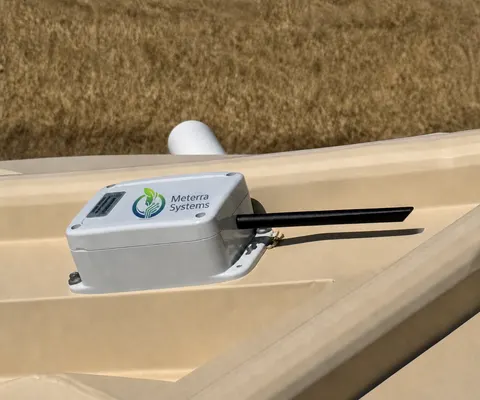
If the job is a stock tank, a cistern, or a tank you cannot see from the house, a Tank Level Sensor reads from above the water, so there is nothing submerged to foul, tangle or weigh down. That is the whole difference: the failure modes in the first half of this page all require something hanging in the water.
If the job is a wet well, lift station monitoring is about the numbers a switch cannot produce. Level, yes, but mainly pump run time and cycle count, which is where a failing pump or an infiltration problem announces itself weeks early.
And keep your low-level float. We are not asking you to take the interlock out. We are asking why the only thing standing between you and a dry pump or an overflow is a device whose own maintenance manual says the only way to know it works is to reach in and lift it.
The hardware this guide covers
Every device reports to the same Meterra dashboard and app.
Tell us what you need to keep an eye on and we'll map the right sensors and coverage.
Frequently asked questions
What is the difference between a float switch and a float valve?
They are different parts doing different jobs and people mix them up constantly. A float valve is plumbing: a float rides the water and mechanically opens or closes a fill valve, which is what refills a stock tank. A float switch is electrical: a float rides the water and opens or closes an electrical contact, which starts a pump or trips an alarm. If your tank overflowed or stopped filling, you are looking at a valve. If a pump did not start or an alarm did not sound, you are looking at a switch.
Why do float switches fail without warning?
Because a stuck float and a normal float send the same thing, which is nothing. Actuation depends on the float being physically free to move and change angle, so a cable tangled on a pipe, a float weighed down by grease or rags, or one wedged against a wall simply stops reporting. There is no error state. That is why maintenance procedures across the wastewater and onsite-septic industries tell operators to physically lift each float to test it rather than to inspect it visually, and why the high-water alarm is the last thing to tell you about a problem rather than the first.
How long does a float switch last?
There is no publicly available service-life or failure-rate figure. We looked through EPA's onsite wastewater manual, EPA's lift station fact sheet, Washington State Department of Health standards, USGS stage-measurement guidance and several state operator-certification manuals. Those documents publish lifetimes for other components, aerators at three to five years for example, and say nothing about floats. What the industry publishes instead is an inspection cadence, which is its real answer: weekly on lift station alarms, monthly to quarterly float cleaning, and annual testing of every switch.
What can I use instead of a float switch?
For continuous level there are four main options. A submerged hydrostatic pressure transducer reads the weight of water above it and is the most common replacement. A non-contact ultrasonic sensor times a sound pulse to the surface. Radar does the same with an electromagnetic pulse and is the least weather-sensitive. Conductance probes and capacitive probes sense electrically. Each has a real weakness: pressure sensors drift and depend on a clear vent tube, ultrasonic is affected by air temperature and density, and radar has a beam footprint that can catch a wall or a ladder.
When should I keep the float switch?
When the decision is genuinely binary and safety-critical, and when a code or a designer requires it. A low-level cutout that de-energises a pump before it runs dry is a true on-off interlock and a continuous reading adds nothing to it. Washington State's standards for some systems require both timer and float switch controls, and recommend a redundant low-level float to guarantee pump submergence. Point-level switches are simple, long-established and cheap. The argument for continuous measurement is about knowing early, not about floats being bad.
How do I dispose of a mercury float switch?
Mercury-containing equipment is federal Universal Waste under 40 CFR Part 273. The container must be closed, structurally sound and undamaged, labelled with wording such as Universal Waste Mercury Containing Equipment, and held no longer than one year. You usually do not scrap the whole pump: guidance from the Interstate Mercury Education and Reduction Clearinghouse notes the float wire can simply be cut and the switch alone sent for reclamation, and that most household hazardous waste programs will take the switch but not the pump. Several states also ban selling mercury switches, though there is no single federal sales ban.
Related Meterra pages
- Catching a Stuck Float Valve Early: the other float, the plumbing one, and how it fails.
- Ultrasonic vs. Pressure Water Level Sensors: choosing between the two main continuous technologies.
- How a Sewer Lift Station Works: where float switches do the most work, and fail the hardest.
- Lift Station Monitoring: continuous level and pump cycles instead of one high-water alarm.
- Tank Level Sensor: non-contact level with nothing in the water to foul.