
How accurate are water level sensors, really?
Two sensors both claiming one percent accuracy can be describing errors that differ by a factor of ten, and neither number is likely to be what limits you in the field. The things that actually decide your reading are a passing weather front, the air temperature between the sensor and the water, where you put the thing, and drift that most datasheets never mention. Here is what each error is worth in inches, with the arithmetic, and how much accuracy each job actually needs. For a stock tank, the honest answer is less than you think.
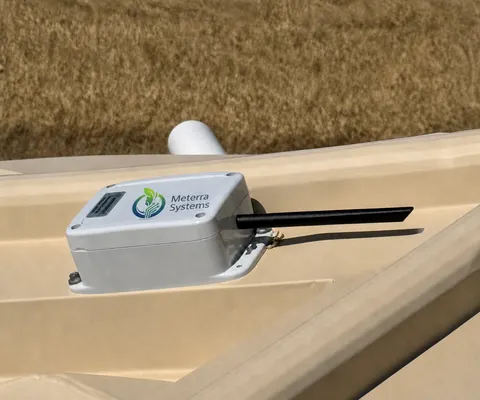
Nobody can compare two accuracy specs, and a federal manual says so
Start here, because it reframes the whole question. The Bureau of Reclamation’s water measurement manual states that to simply call a meter 3 percent accurate is incomplete, and that no universal definition of these terms exists.
That is not pedantry. Here is the distinction that does the damage.
Percent of full scale is a fixed error expressed against the sensor’s whole range. On a sensor ranged for 30 feet, 1 percent of full scale is 3.6 inches, and it is 3.6 inches whether the tank is full or holds six inches of water.
Percent of reading scales with what you are actually measuring. At 2 feet of water, 1 percent of reading is a quarter of an inch.
Same number on the datasheet. Roughly a factor of ten apart in the case that matters, which is usually the low end, because low is when you care. A sensor sized generously for a tank you might build later is a sensor whose full-scale error is now sitting on top of the readings you take every day.
A few other words get used loosely and mean different things. Resolution is the smallest change the device reports, and it is not accuracy. Repeatability is whether you get the same answer twice under the same conditions. Linearity and hysteresis describe how the response bends, and whether it bends differently on the way up than on the way down. A total error band that includes all of them is the only honest single figure, and it is rarer than it should be.
The two errors that dwarf the datasheet
Barometric pressure, for submerged sensors
A submerged pressure sensor measures the weight of what is above it. If it is an absolute sensor, what is above it includes the entire atmosphere.
The conversion is the thing to memorise: 1 inch of mercury equals 13.60 inches of water.
So a 1 inHg swing, which is an ordinary frontal passage rather than a storm of record, moves an uncompensated absolute sensor by 1.13 feet. At one US weather station the record barometric range is 2.51 inHg, which works out to 2.84 feet of apparent water level that was never there.
There are two correct answers. A vented or gauge sensor runs a small tube up through the cable to the atmosphere, so the back of the diaphragm sees the same barometric pressure the water surface does and it cancels. Or you use an absolute sensor and log barometric pressure separately, then subtract.
The vented approach has its own failure mode, and USGS is direct about it: vent tubes on long cables have more chance of clogging, and moisture tracking down the tube reaches the electronics. That is what the desiccant in the cable termination is for, and a saturated desiccant is a maintenance item, not a spare part.
Air temperature, for ultrasonic sensors
An ultrasonic sensor times a pulse of sound to the surface and back, then halves it. That arithmetic needs the speed of sound, and the speed of sound in air depends on temperature.
Work it through. Taking the standard relation, sound travels at about 331.3 m/s at 0 C and 343.2 m/s at 20 C. The sensitivity around room temperature is:
- The derivative at 0 C is 331.3 divided by (2 x 273.15), which is 0.606 m/s per degree C. Using the two endpoint values above instead gives 0.625, about 3 percent higher. That gap is the linear approximation, and it is worth knowing the two figures are not the same number.
- As a fraction: 0.606 divided by 343.2 is 0.177 percent per degree C.
Because distance is speed multiplied by time, that error is proportional. It grows with range rather than sitting there as a fixed offset:
| Uncompensated swing | Error as percent | Over 3 m | Over 10 m |
|---|---|---|---|
| 1 degree C | 0.18 % | 0.21 in | 0.70 in |
| 10 degrees C | 1.8 % | 2.1 in | 7.1 in |
| 20 degrees C | 3.5 % | 4.2 in | 14.2 in |
Fourteen inches over ten metres, from weather. And the sensor is not broken.
Two things follow. First, compensation is not optional at any real range: USGS states that without correcting for air temperature and density, the acoustic method has trouble meeting its accuracy standards for primary records, especially beyond about 10 feet of air gap.
Second, and less well known, compensation has a residual. A sensor with a thermometer on its body corrects for the temperature at the body. What matters is the temperature along the whole path, and a sun-warmed headspace over cold water is exactly the case where those differ. The best-engineered acoustic level system in US federal service handles this by measuring against a fixed reflector about four feet down the same air path, so it reads the real sound speed instead of modelling it, and NOAA still lists temperature-induced sound speed gradients in the sounding tube as a named residual error. If the best implementation in the country has not fully solved this, treat any claim that a body thermistor solves it with suspicion.
Two geometry problems that decide whether a sensor works at all
Dead band, which is the one that bites on shallow tanks
A single transducer both transmits and receives, so after it fires it keeps ringing, and it cannot hear an echo until that ringing dies away. USGS describes exactly this for its acoustic instruments: a short delay is needed after transmitting to let acoustic ringing decline enough that a received signal can be interpreted. That delay, expressed as a distance, is the blanking or dead band, and the sensor is blind inside it.
The consequence is scale dependent, and it is the single strongest reason a spec that looks fine on a silo is useless on a trough. Suppose a sensor has a one foot dead band:
- On a 30 foot tank, that removes about 3 percent of the depth. Irrelevant.
- On a two foot stock trough, it removes half of it, and it removes the half you care about, because the dead band eats the top of the range. The sensor goes blind exactly when the tank is full.
We are deliberately not quoting a typical blanking distance, because every figure we could find came from a manufacturer selling one. Get the number from your own sensor’s specification, then do the division above against your actual tank. That two line calculation disqualifies more sensors on shallow vessels than any accuracy figure ever will.
Beam spread
The pulse leaves as a cone, so it illuminates a circle on the water, and anything else inside that circle can return an echo first. USGS advises routine checks that the footprint is free of obstructions such as debris and boulders, and separately warns about the signal bouncing off a pier.
Worth flagging carefully: USGS publishes the example that an 8 degree beam gives a 7 foot footprint at 25 feet of air gap. Check that arithmetic and it only reproduces if the 8 degrees is treated as a half angle, giving 2 x 25 x tan(8) = 7.03 ft. Under the more common convention where the quoted angle is the full included angle, the same sensor would give 3.5 feet. So the published footprints are twice what the usual convention implies. We are not claiming USGS is wrong, and we would not bet against them on conservatism, but if you are comparing beam specs between two documents, confirm which convention each is using or your comparison is off by a factor of two.
Either way the practical point holds: on a narrow tank at any real mounting height, the cone sees the wall.
The error nobody puts on the datasheet: drift
A 99 day field trial across fourteen brands of pressure transducer found drift ranging from negligible to 27 mm on low range models and up to 181 mm on higher range ones, with some units failing to meet their own manufacturer’s stated accuracy.
The authors’ conclusion is the sentence to take away: drift is not often cited in product specifications, but may be the key accuracy determinant during a long deployment.
The same work notes there is no industry-wide calibration standard for water level pressure transducers, so specifications from different manufacturers are not directly comparable. Keep that beside the Reclamation quote at the top. Two datasheets are not two measurements of the same thing.
USGS builds the response into procedure rather than into the purchase: check the transducer against an actual water level in the well on every visit, and recalibrate periodically. Pressure transducers, it notes, are subject to drift, offset, and slippage of the suspension system, and rapid repeated level swings fatigue the diaphragm in a way that shows up as accelerated drift.
Where you put it beats what you bought
This is the part that reorders everything above.
USGS documents drawdown and buildup around structures on the order of half a foot or more. The USGS system accuracy standard is a hundredth of a foot. Mounting a perfect sensor in a bad spot introduces roughly fifty times the entire allowance for the instrument.
The usual suspects:
- No known datum. A reading is a number until you know what it is measured from. If the sensor moves, or the suspension slips, every historical value shifts with it.
- Sediment. A submerged sensor slowly buried reads progressively shallower, and it does it gradually enough to look like a real trend.
- Wind and waves on open water. Wind pushes water to one end of a pond. The stilling well exists for exactly this, and it is the oldest fix in the business.
- Obstructions in the footprint for non-contact sensors, per the section above.
And level is not volume
Converting a level reading into gallons introduces an error that has nothing to do with the sensor. A vertical cylinder is easy. Almost nothing else is. A pond with a sloped bottom, a tank that is not a uniform shape, a dam with varying surface area: each needs a surveyed stage to storage relationship, and that survey has its own error budget.
Put numbers on it, because the comparison is stark. A USGS bathymetric study of a small reservoir measured how much the computed capacity moved as survey density dropped: against a 50 foot control spacing, transects at 100 feet changed capacity by 1.1 percent, at 200 feet by 5.1 percent, at 400 feet by 15.6 percent, and at 800 feet by 36.8 percent. Now compare a sensor. On a one acre pond averaging five feet deep, a level error of 0.01 ft, which is the full USGS stage standard, works out to 0.2 percent of volume.
So a sparse survey can be wrong by fifteen percent while a hundredth-of-a-foot sensor is wrong by two tenths of one percent, and the two errors do not compete because they enter through different terms. A perfect level reading on a curve that is twenty percent wrong still gives you a volume that is twenty percent wrong. That comparison is our arithmetic on USGS figures, not a sentence we found in a federal document, but the inputs are theirs and you can check it.
One asymmetry worth carrying: a stale table errs in one direction only. USGS notes that sedimentation reduces a lake’s capacity over time, so an old area and capacity table overestimates the water you have.
The reason USGS holds reservoirs to the same tight stage standard as streams is precisely this: surface area is large, so a small stage error integrates into a large volume error. That mechanism is why a reservoir needs hundredths of a foot. It is also why a stock tank does not.
So how accurate do you actually need?
The federal answer is refreshingly blunt. USACE’s dam instrumentation guidance states that the accuracy required is dictated by the amount of change that needs to be detected: if half an inch of movement matters, the tool needs accuracy appropriate to that, and an instrument good only to an inch will not do.
Which means the right question is never “how accurate is this sensor,” it is “what is the smallest change that would change what I do.” Here is the range, from real standards:
| Job | Required accuracy | Source |
|---|---|---|
| Stock tank or livestock trough | No standard exists. Float valve, full versus empty | NRCS practice standard 614 |
| Water right, small diversion (California) | ±15 % by volume | 23 CCR §933(d) |
| Water right, large diversion (California) | ±10 % by volume | 23 CCR §933(d) |
| Installed meter field trigger (Idaho) | ±5 % magnetic or ultrasonic | Idaho DWR, 2025 |
| Commercial water meter, legal metrology | ±1.5 % | NIST Handbook 44 |
| USGS groundwater transducer | 0.01 ft, 0.1 % of range, or 0.01 % of depth, least restrictive | USGS GWPD 16 |
| USGS stage, streams and reservoirs | ±0.01 ft or 0.2 % of effective stage | USGS TM 3-A7 |
Two honest notes on that table. The California and Idaho figures are volume and flow tolerances, and the NIST figure is a volumetric meter tolerance, so none of them convert cleanly into a level tolerance. They are there to show the magnitude of what regulated measurement actually demands, which is percent, not hundredths of a foot. And the USGS groundwater rule is worth reading twice: it takes the least restrictive of three terms, so the allowance grows with depth. At 300 feet of depth to water it works out to 0.03 ft, not 0.01.
On the stock tank line, the absence is the finding. We went looking in NRCS conservation practice standard 614, which is the federal document governing livestock watering facilities and the place such a requirement would live. It specifies a float valve. It specifies flow, at 2 gallons per minute per head for large livestock. It says to check the performance of the automatic water level device. It contains no measurement accuracy requirement of any kind, because the question the standard cares about is whether enough water arrives, which is not a question about hundredths of a foot.
The most useful thing we read, and it counts against us too
The Bureau of Reclamation field-tested nineteen water level sensors across these technologies. Their conclusion deserves quoting in full, and it does not spare anything we sell:
It became abundantly clear to the researchers that all manufacturers and styles of water level loggers are prone to issues. Several of the sensors installed in the field went dead for no apparent reason. It is highly recommended that redundant sensors be placed at all critical measurement locations.
Two field findings from that programme are worth more than most spec sheets. Spider webs blocking the signal topped their list of biggest issues encountered with ultrasonic sensors, ahead of any of the physics above. And their own price record, hardware only and purchased between 2011 and 2015, put submersible pressure sensors between about $280 and $1,045 and ultrasonic between about $235 and $860. They disclaim the currency of those figures, and so do we, but it is the only vendor-neutral pricing on this subject we found anywhere.
What we would actually tell you to do
For a stock tank, a cistern, a pond, or a well on a working place, here is the honest ranking of what to spend your attention on.
First, get the technology right for the vessel. Non-contact for tanks where you do not want anything in the water, submerged pressure for open water and depth. That decision is covered in ultrasonic versus pressure sensors and it matters more than any accuracy figure.
Second, check the dead band against your actual depth. Two lines of arithmetic. It disqualifies more sensors on shallow tanks than anything else on this page.
Third, mount it properly and write down the datum. Fifty to one against the instrument spec, remember.
Fourth, plan to check it. Compare against a real measured level occasionally. Drift is the error that is not on the datasheet and it is the one that will eventually fool you.
Then, and only then, worry about the accuracy number. For deciding whether to haul water tomorrow, an inch is a rounding error and a trend line over a week is worth more than any hundredth of a foot ever will be. A Tank Level Sensor or a Dam Level Monitor is sized for that job: knowing, from the house, which tank is dropping faster than it should. If you are reporting to a state engineer or computing reservoir storage, you are in a different tier of the table above, and you should be reading the USGS procedures rather than a vendor’s page. Including ours.
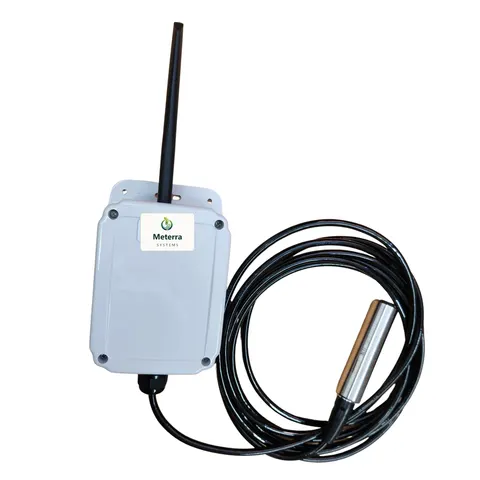
The hardware this guide covers
Every device reports to the same Meterra dashboard and app.
Tell us what you need to keep an eye on and we'll map the right sensors and coverage.
Frequently asked questions
What does 1 percent accuracy mean on a level sensor?
It depends entirely on whether it is 1 percent of full scale or 1 percent of reading, and that single distinction can be a factor of ten. On a sensor ranged for 30 feet, 1 percent of full scale is 3.6 inches of error at every depth, including when the tank holds 2 feet of water. One percent of reading at that same 2 feet is a quarter of an inch. The Bureau of Reclamation's water measurement manual says outright that calling a meter 3 percent accurate is incomplete, and that no universal definition of these terms exists.
Do I need a vented pressure sensor or can I use an absolute one?
It matters more than almost any spec on the datasheet. An absolute sensor reads the water above it plus the atmosphere above that, so barometric pressure moves the reading. One inch of mercury equals 13.60 inches of water, and a 1 inHg frontal passage is ordinary weather. That alone shifts an uncompensated absolute sensor by about 1.13 feet, which is larger than most people's entire error budget. Either use a vented sensor, which references atmosphere through a tube in the cable, or log barometric pressure separately and subtract it.
How much error does air temperature cause on an ultrasonic sensor?
About 0.18 percent of the measured range per degree Celsius, because the speed of sound in air changes with temperature. Worked through: a 20 degree C swing with no compensation is roughly 3.5 percent, which is about 4 inches over a 3 metre range and about 14 inches over 10 metres. USGS states that without compensating for air temperature and density, the acoustic method struggles to meet its accuracy standards, particularly where the sensor sits more than about 10 feet above the water.
How accurate does a stock tank sensor need to be?
There is no standard, and that is a searched answer rather than a shrug. The federal NRCS conservation practice standard for watering facilities is the document that would contain such a requirement, and it contains no measurement accuracy figure at all. What it specifies is a float valve and a flow rate, 2 gallons per minute per head for large livestock. The design question is whether enough water arrives, not what fraction of an inch the surface sits at. Inches are plenty. On a shallow trough the sensor's dead band matters far more than its accuracy spec.
What is the biggest source of error in practice?
Usually not the sensor. USGS documents drawdown and buildup around structures on the order of half a foot or more, against a sensor standard of a hundredth of a foot, so where you mount it can outweigh what you bought by roughly fifty to one. After that comes drift, which a 99 day trial across fourteen brands measured at up to 181 millimetres on higher range units, and which the authors note is often absent from published specifications despite being the key accuracy determinant on a long deployment.
How often should a level sensor be calibrated?
USGS groundwater procedure is to check the transducer reading against an actual measured water level on every site visit, and to recalibrate periodically and at the end of monitoring. That is the practice worth copying, because it catches drift and it catches the sensor having quietly moved. A single reference point corrects an offset only. Correcting a slope error, where the sensor reads progressively worse with depth, requires two points at different levels.
Related Meterra pages
- Ultrasonic vs. Pressure Water Level Sensors: choosing the technology, before you worry about its error budget.
- Wireless Float Switch Alternatives: what to use instead of a switch, and what defeats each option.
- How to Choose a Water Monitoring System: the whole-system decision this page is one input to.
- Tank Level Sensor: non-contact ultrasonic, for tanks and cisterns.
- Dam Level Monitor: submerged pressure, for ponds and open water.
- Video: Ultrasonic vs. Pressure, On a Job Site: both sensor types compared side by side.
- Water Level Monitoring Systems: how ultrasonic and pressure sensing work, and where each fits.