Does Your Utah Well Need a Flow Meter? What the State Actually Requires
Utah has no single statute saying every well must carry a flow meter. What it has is more effective in practice: Utah Code § 73-5-4 gives the state engineer authority to require measuring devices on diversions, and the Division of Water Rights uses it — many well approvals now carry an express condition requiring a functioning totalizing meter plus water-use reporting, and some counties enforce metering as a condition of the right to divert. So the real question is not "does Utah require meters" but "does my authorization carry the condition." This guide shows you how to check, what a totalizing meter is, and how to make the reporting side a five-minute export instead of a year-end scramble.
What Utah law actually says about metering wells
There is no line in Utah code reading “all wells shall be metered.” The machinery is quieter and, in practice, more binding. Utah Code § 73-5-4 authorizes the state engineer to require controlling works and measuring devices on water diversions. The Division of Water Rights (DWRi) applies that authority through the conditions it writes onto water rights: many well approvals and change applications now carry an express requirement for a functioning totalizing meter, along with periodic water-use reporting.
Local government stacks on top. Summit County, for example, requires meters and readings on wells as a condition of the right to divert. In basins under active regulation, distribution and groundwater-management programs bring their own measurement expectations.
So the honest answer to “does my Utah well need a flow meter” is: check your authorization. If the condition is written into your approval, the requirement already attaches to your right, whether or not a meter is on the pipe today. And if you’re drilling or amending a right now, expect the condition — that’s the direction every new authorization is moving.
How to check whether your well carries the condition
- Pull your water right. Look it up on the Division of Water Rights site by name or right number and read the approval documents attached to it.
- Search the conditions for the words that matter. “Totalizing meter,” “measuring device,” “water use reporting,” and any named reporting frequency.
- Check your county and basin. County well-meter rules and basin groundwater-management plans can add requirements beyond the right itself.
- When it’s ambiguous, ask. DWRi’s regional offices answer exactly this question all day. A ten-minute call beats guessing about a condition on a property asset.
What “totalizing meter” means, in plain terms
A totalizing meter counts cumulative volume: total gallons (or acre-feet) through the line since the count began. That’s different from a gauge that only shows the current flow rate. Reporting runs on totals, because the state’s question is how much water the well diverted over the season or the year.
A mechanical register totals on a dial at the wellhead, which works — as long as someone drives out, reads it, writes it down, and doesn’t lose the notebook. A wireless meter does the same counting but keeps the running total and the full history somewhere more useful than a dial in a pump house.
The meter is one-time work. The record is forever work.
Installing the meter satisfies the visible half of the condition. The half that catches people is the reporting: when the form is due, someone has to produce credible numbers for the period. Reconstructing a year of use from one or two register readings and memory is the scramble — and it produces exactly the coarse, questionable data that makes audits tense.
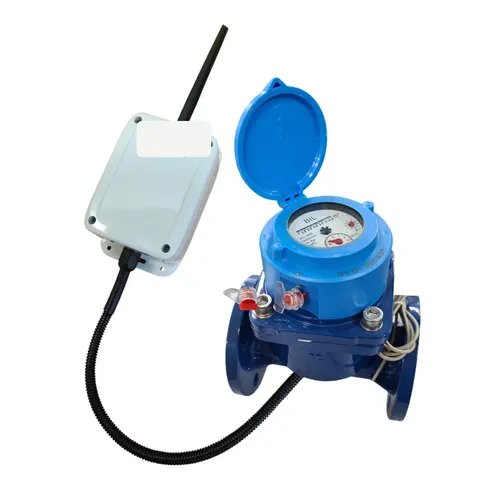
This is where an hourly record changes the job. Meterra’s water flow monitor is a turbine meter that counts every gallon and reports the total used each hour, over cellular, on battery power that lasts 3+ years — no power drop or Wi-Fi at the wellhead. The software turns that history into average flow rates and totals for any period: the day, the month, the season, or the exact window a report asks about. When reporting comes due, the record already exists, timestamped and exportable.
Two honest notes. First, whether a particular meter satisfies the condition on your right is DWRi’s determination, and some programs are specific about meter types or accuracy verification — send us your condition’s wording and we’ll confirm fit before anything ships. Second, the same hourly record moonlights as protection you’ll use more often than the report: usage in hours when nothing should be running is how a leak or a stuck valve announces itself while it’s still small.
If the water table itself is the worry — a well that seems slower to recover every August — metering pairs naturally with well water level monitoring, so you can see draw and drawdown side by side.
Utah isn’t alone
Measurement requirements are spreading across the West and beyond, each state through its own machinery. New Mexico’s Office of the State Engineer runs a metering program with monthly meter readings for irrigation, municipal, commercial, and industrial uses. Washington’s Department of Ecology enforces statutory metering on many rights. In California, groundwater agencies and districts are phasing in meters — one conservation district makes flow meters mandatory for production reporting starting July 1, 2026. Texas groundwater conservation districts require measurement on non-exempt wells, and Georgia has been metering agricultural withdrawals under a state program for two decades.
The pattern is consistent: the meter becomes a condition of pumping, and the operations that treat the record as an asset rather than a chore stop thinking about compliance at all. If you run wells in more than one state, or you’re the agency on the other side of these forms, our water agencies page covers the program-scale version of the same idea.
Getting set up
Tell us the pipe size, where the well sits, and what your condition or reporting form asks for. We’ll confirm cellular coverage at the site, confirm the meter fits the requirement as written, and get you a current US price — and the record starts building from the first hour it’s on the line.
The hardware this guide covers
Every device reports to the same Meterra dashboard and app.
Tell us what you need to keep an eye on and we'll map the right sensors and coverage.
Frequently asked questions
Does every well in Utah need a flow meter?
Not by one blanket law. Metering in Utah is condition-based. Utah Code § 73-5-4 gives the state engineer authority to require measuring devices, and the Division of Water Rights attaches totalizing-meter and reporting conditions to many well approvals and change applications, with some counties and basins adding their own requirements. Whether YOUR well needs one depends on the conditions written into your water right, so read your approval or look the right up on the Division's site. The clear trend is that new authorizations carry the condition.
What is a totalizing meter?
A meter that counts cumulative volume — the total gallons or acre-feet that have passed through the line — rather than only showing the flow rate at a glance. The total is what reporting asks for, because the state wants to know how much water was diverted over a period, not how fast it was moving at any moment. A mechanical register totals on a dial you drive out and read; a wireless meter keeps the count and the history where you can see it from anywhere.
Will Meterra's flow monitor satisfy my metering condition?
It is a turbine meter that counts every gallon and reports the total used each hour, so the cumulative record the state cares about is always current and exportable. The condition language on rights varies, though, and whether a given meter satisfies yours is the Division of Water Rights' call — some programs specify meter types or accuracy checks. Send us the wording from your approval and the pipe size, and we'll confirm fit honestly before anything ships.
What happens if I ignore a metering condition?
The condition is part of the right itself, and the state engineer has enforcement tools for rights that are out of compliance. Just as important, unmeasured use is hard to defend — in an audit, a distribution dispute, or an adjudication, the well with a clean usage record is in a far stronger position than the one with an estimate. If you've received a letter about metering or reporting, talk to your Division of Water Rights regional office rather than letting it sit.
How do I report my well's water use in Utah?
Through the Division of Water Rights' water-use reporting program, at the frequency your right or basin requires — commonly annual totals, more frequent in some regulated areas. That is where an automatic usage history earns its keep. If the meter has been logging gallons every hour all year, the report is an export, not a reconstruction from memory and a dial photo from last spring.
Related Meterra pages
- Water Flow Monitor: the wireless turbine meter that reports gallons used, hour by hour.
- For Water Agencies: the program side, telemetry across many metered diversions.
- Well Water Level Monitoring: watch the water table alongside the pumped volume.
- Finding Leaks with Flow Data: the other job the same meter does on the same line.