Power failure alarm for wells, barns and stock water
To get an alert when the power goes out at a well, barn or stock-water system, put a cellular power monitor on the circuit that matters, set a power off alert, and add a second person to the account who can get to the site. The monitor has to report without the outlet it watches and without the farm Wi-Fi, because both die in the same outage. Then have a plan for the water, because the alert is only the start.
By Meterra Systems · Published
The short answer: put a power monitor that reports over the cellular network on the circuit you care about, set a power off alert, and add a second person to the account. Then decide now what you will do for the animals when it fires, because the alert tells you the water stopped. It does not bring it back.
An outage alarm can fail in one of two quiet ways. Either the alarm depends on the same power it is watching, or it reports through the farm Wi-Fi, which goes dark in the same outage. A useful alarm avoids both. The rest of this guide covers what to look for, how to read the alert when it comes, and the hours after it, when the work is about water, not electronics.
If your question is about one pump that keeps quitting, our guide to knowing the moment a well pump stops walks through that failure chain. This guide is about losing power at a whole site: the well, the barn, the pumphouse, the stock-water system.
Why a power outage hurts stock water so fast
Purdue puts it plainly: winter storms can cause long outages, which is harder on an operation that depends “on well water and an electric pump.” No power means no pump, and in cold weather it often means no tank heater either. The Idaho Office of Emergency Management tells residents to “have a plan for livestock water needs if well pumps lose power,” which is the same point from the emergency side.
The demand does not pause. NDSU Extension puts beef cattle at “8 to 10 gallons per day,” and its veterinarian notes that cattle do not adapt to eating snow as a water source very quickly. Do the arithmetic for your own herd: 50 cows at 8 to 10 gallons is 400 to 500 gallons a day that has to come from somewhere other than the well while the power is off.
That is why the alert matters. An outage at 2 a.m. found at the 7 a.m. chores costs you five hours of storage and five hours of ice. An outage you hear about at 2 a.m. gives you those hours back to start a generator, open stored water or call for help.
What a power failure alarm needs to work in a real outage
Any alarm can tell you the power is off while the power is on. The test is what happens when the lights go out. Look for four things.
1. A reporter that does not die with the outlet. The part that sends the message has to run on its own battery. A box that plugs into the dead outlet and has no battery cannot tell anyone anything. Our Power Monitor sits between the outlet and the equipment, and its communications unit has its own battery, listed as “3+ years for the communications unit” on the setup sheet. That is the battery figure on the sheet; it is not a figure for how long the unit keeps reporting through an outage.
2. A connection that does not run through the building. Farm Wi-Fi needs a powered router, and the router is on the same grid. A cellular unit talks straight to a tower. The Meterra monitor reports over cellular, so a pumphouse or remote shed works fine without Wi-Fi at the building, and coverage is confirmed for your location before anything ships. If a site has weak service, our guide to cellular and satellite monitoring covers the options.
3. An alert, not just a reading. A dashboard you have to open is a history, not an alarm. The monitor gives “an alert the moment the power goes on or off,” and the setup step is to set a power off alert “so a tripped breaker or a dead outlet reaches your phone the minute it happens.” Set the power on alert too: it tells you when you can stop hauling.
4. More than one person. One person in another town is a single point of failure. The monitor supports multiple accounts and users, so add whoever can actually get to the site.
Be honest with yourself about one limit: cell sites need power too. The FCC reported in a 2021 rulemaking notice that “the majority of cell site outages” in the immediate aftermath of Hurricane Ida’s central disaster region “were due to a lack of commercial power availability” (FCC 21-99, 2021). In a long regional outage, any cellular alarm can go quiet along with everything else. If a big storm is coming, plan as if you may not hear from the site, and treat silence during a regional outage as a reason to check, not as good news.
Where to put it
Put the monitor on the load whose loss costs the most. The product page names “well and transfer pumps, stock-water pressure systems, coolers and freezers” as the usual places.
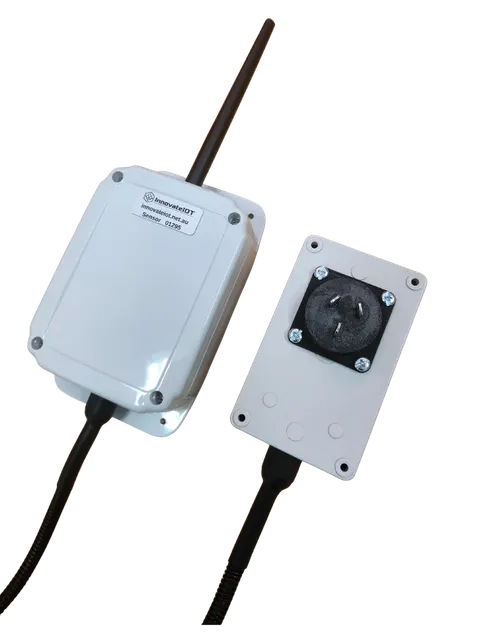
- Plug-in loads. The monitor fits standard NEMA 5-15 / 5-20 outlets between the wall and the equipment. Plug the monitor into the outlet, plug the equipment into the monitor, and the first reading can take up to 10 minutes. No wiring.
- Wired-in pumps and motors. Many pumps are not plugged in at all. For those, the setup sheet is direct: pumps and motors that are wired in rather than plugged in use a current clamp around the supply cable instead of the outlet box. Tell us what the equipment is and how it is fed, and we configure the right version. Any work inside a panel is a job for a qualified electrician or pump professional.
- A whole outbuilding. If what you want to know is whether the barn has power at all, put a plug-in monitor on an outlet on the barn’s circuit that you never switch off. It will tell you when that circuit loses power, which covers a utility outage at that building.
Because the monitor also logs power-on run-time totals, read every 60 minutes (more frequent on request), it does a second job between outages: the history shows whether the pump is running more than it used to. A pump that runs far longer than normal is worth a look, which our well pump short cycling guide covers from the other direction.
When the alert fires: outage, breaker or something else
A power off alert tells you the equipment lost power. It does not tell you why. The first check is the one Nebraska Extension gives in its 2012 well guide for a well that stops delivering water: “first check that there is electrical power in the house by turning on electrical appliances on a different circuit.” Then check the breaker box. If that does not fix it, call a licensed professional.
| What you see | Most likely cause | What to do |
|---|---|---|
| Every monitor at the place went off at once, and the utility’s outage map or alert agrees | Utility outage | Report it to the power company (Idaho OEM: call the provider, “not 911”), start your water plan |
| One monitor went off, the house and other buildings have power | Tripped breaker, dead outlet or a local fault | Check the breaker box; if the problem persists, stop and call an electrician or pump professional |
| Power is on, but the tank level keeps falling | The pump or plumbing, not the power | See the tank and pump checks in know when the well pump stops |
| No alert, but nothing has reported for hours during a regional storm | The site or the nearby cell sites may be without power | Check the site or have a neighbor check; do not assume all is well |
Two monitors make this much easier. A power monitor on the pump and a tank level sensor on the tank it feeds tell you both the cause and the consequence. In the product page’s words, the power monitor proves it’s drawing current, and the tank sensor confirms the water arrived. If you also want to start and stop a pump from your phone once power is back, that is the job of a pump controller.
The Idaho page adds a simple step: make sure your power company has your current contact details, so you get its outage notices too. Two independent alerts are better than one.
The hours after the alert: a stock-water plan
This is the part the alarm cannot do for you. Write it down before winter and keep it where whoever answers the alert can find it.
Stored water. Purdue’s guidance is to store large quantities of water in insulated tanks or containers before an expected storm, especially if a generator is not available, and it adds that “pre-filled troughs or portable water tanks can supply livestock during power outages.” The New Jersey Department of Agriculture says the same for any disaster: make sure livestock have stored feed and stored water available in a readily accessible place. Use the NDSU figure to size it: gallons per head per day times head times the number of days you want to cover.
Ice. Purdue says that during outages you should be prepared to break ice on troughs with hand tools, and that this “may need done several times each day in extremely cold weather.” It also notes that moving water does not freeze as quickly, and that insulating storage tanks and pipes slows freezing. None of this needs power, which is the point.
A generator, done safely. NDSU calls a generator “one option for restoring power to pumps and heated livestock watering systems,” with conditions:
- Match the voltage. NDSU notes that some wells need 110 volts and some heated waterers need 220 volts, so the generator has to supply what your equipment needs. New Jersey also says to make sure the generator can handle your loads.
- Have the right connections. NDSU warns that a pump or watering system that is not wired for a generator needs proper connections, and that installing that wiring takes care. Have a qualified electrician set up the connection and transfer arrangement before the storm, not during it.
- Keep it outside and away. Ready.gov says generators and fuel go outdoors “and at least 20 feet away from windows, doors and attached garages.” The CDC gives the same 20 feet from any window, door or vent and says to use a battery-powered or battery backup carbon monoxide detector in the home. NDSU adds that carbon monoxide is very toxic to humans and animals, so never run a generator in an enclosed or partly enclosed barn.
Animals that stop drinking. NDSU flags cattle that stop drinking or drink far less as a serious problem. If that happens, call your veterinarian. This guide gives no treatment advice.
The freezer and the cooler. If the outage also hits a freezer or a refrigerator, the CDC says a full freezer keeps food safe for 48 hours (24 if half full) and a refrigerator for up to 4 hours, if you keep the doors shut. For animal medicines, follow the label and ask your veterinarian.
What a power alarm cannot do
A power monitor reports. It does not restore power, start a generator, thaw a line or keep a tank from freezing. It cannot tell a utility outage from a tripped breaker on its own, and in a long regional outage it depends on cell sites that may be down too. Our winter stock-water guide goes through the same limits for level sensors in a freeze.
What it does is take the surprise out of the morning. You learn about the outage while there is still time to use your stored water, your generator and your neighbors, instead of finding a dry or frozen tank at chores.
Next step
Pick the one outlet or pump whose loss would hurt most this winter, and start there. The Power Monitor page covers how it works; US pricing for the power monitor is being finalized as part of our rollout, so ask us for current pricing. If you are planning a whole site, browse the full lineup on products or tell us what the equipment is and how it is fed, and we will configure the right version.
The hardware this guide covers
Every device reports to the same Meterra dashboard and app.
Tell us what you need to keep an eye on and we'll map the right sensors and coverage.
Frequently asked questions
How do I get a text when the power goes out at my barn?
Use a power monitor that reports over the cellular network rather than the barn's Wi-Fi, because the Wi-Fi router loses power in the same outage. Plug it in on the circuit you care about, set a power off alert in its app, and add another user to the account so the site does not depend on one person.
Will a power outage alarm work if the power is out?
Only if the part that sends the alert has its own battery and a connection that does not run through the building's power. A cellular unit with a battery can report the loss. A Wi-Fi alarm usually cannot, since the router goes down too, unless the router is on a battery backup. Long regional outages can also take nearby cell sites down.
Can a power monitor tell a tripped breaker from a utility outage?
Not by itself. It tells you the equipment lost power. Nebraska Extension's first check when a well stops delivering water is to see whether there is power on a different circuit, then check the breaker box. If the house has power and the pump circuit does not, suspect a breaker; if nothing has power, it is most likely the utility, so report it.
How long can cattle go without water in a power outage?
The NDSU Extension article cited here gives no figure for how long, so do not plan around one. It puts beef cattle at 8 to 10 gallons per head per day and says cattle do not adapt to eating snow quickly. Have stored water, a way to break ice, and a safe generator plan before a storm, and call your veterinarian if animals stop drinking.
Do I need an electrician to install a power failure alarm?
Not for a plug-in monitor, which goes between the outlet and the equipment. Equipment that is wired in rather than plugged in needs a current clamp, and any work inside a pump panel or with generator connections belongs to a qualified electrician or pump professional.
Related Meterra pages
- Power Monitor: The plug-in power failure alarm for pumps, freezers and outbuildings.
- Know the moment a well pump stops: The failure chain for one pump, from tripped breaker to dry tank.
- Monitoring stock water in winter: What monitoring can and cannot see in a freeze.
- Power Monitor setup sheet: How the monitor plugs in and how to set the power off alert.
Newest guides
- Tank Level Indicator, Gauge or Monitor: Which Do You Need?: What a level indicator, a gauge and a remote monitor each do, where each one fails, and a simple rule for which to buy for a poly tank, cistern, stock tank or tote.
- Well Pump Short-Cycling: What It Means and What the Water Level Shows: A rapid on-off pattern can mean a waterlogged tank, a bad switch, a leak, or a well running low, and the water level during cycling tells you which.
- Slow Well Recovery: How to Measure Your Well's Recovery Rate: How to measure static level, drawdown, and recovery by hand or with a sensor, and turn the result into a pumping schedule and a days-of-water number.