Tank level indicator, gauge or monitor: which do you need?
An indicator or gauge shows you the level only when you look at it. A monitor reads the level on a schedule and sends it to your phone, and it can alarm when a tank runs low or overfills while you are somewhere else. If you walk past the tank every day, a cheap gauge is often enough. If you do not, you need a monitor. Here is how to sort it out by tank type.
By Meterra Systems · Published
An indicator or a gauge shows you the level when you are standing at the tank and looking at it. A monitor measures the level on a schedule, sends it to your phone, and can alarm when the tank runs low or overfills. That is the whole difference, and it decides which one you need.
Ask one question: will you see this tank before it matters? If you pass it every day and a rough reading is enough, a plain indicator is the right buy, and we will say so. If the tank is out of sight, on the far side of the place, or one of several, a gauge only tells you what you could have found by driving out. A monitor tells you without the drive.
The words overlap in the stores, so do not shop by the name on the box. Shop by the question each one answers.
What each one actually does
Indicator. Usually the simplest thing that shows a level by eye. The New Mexico Office of the State Engineer describes a level reader that “can be as primitive as a stick with units of measurement etched on the side.” North Carolina’s environmental agency puts it the same way for cisterns: the simplest level indicators attach to the exterior of the tank and give a quick visual indicator of the water level. The same North Carolina chapter calls a cistern level indicator “a recommended component,” so for a cistern this is not a luxury.
Gauge. Usually easier to read than a stick, and still read by eye. The Texas Water Development Board’s rainwater manual describes one Texas example, a float and rod arrangement where “the length of rod protruding from the tops of tanks indicates water level.” Dials and exterior sight tubes are other ways to show the level by eye. None of these needs power, batteries or a connection.
Float switch. Often sold next to gauges, but it is a different thing. A float tells you the level crossed a point. It does not tell you the level, the trend or how fast the water got there, which is why it is a trigger and not a gauge. North Carolina’s guidance lists a float switch, a pressure transducer or a level indicator as the usual ways to start make-up water in a cistern. If you are weighing a float against a sensor, our guide to a wireless float switch alternative covers that trade, and what a stuck float valve looks like covers how floats fail.
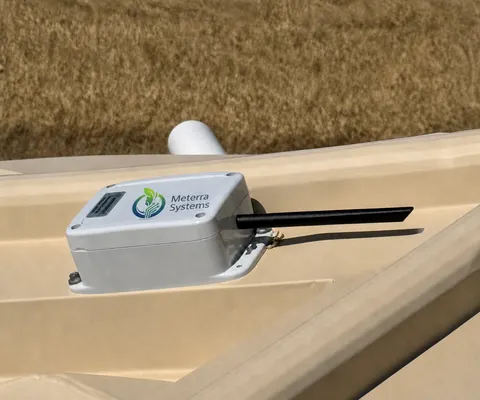
Monitor. A sensor that reads the level itself, a radio that sends it, and an app that keeps the history and sends alerts. The Meterra Tank Level Sensor is one of these. It is a wireless ultrasonic unit: the sensor “reads the surface from above, so there’s no probe to corrode or foul,” and you can set thresholds so you get an alert “the moment a tank runs low or overfills, before it becomes a problem.” The same tool that reads the level also watches the trend, so a slow leak shows up as a line pointing the wrong way.
Where each one fails
Every method has a failure that is easy to miss until it costs you something.
- Indicators and gauges report only when someone looks. That is not a defect, it is the design. The failure is relying on one for a tank you do not see.
- Float switches report one height. Between the “low” float and the “full” float you know nothing.
- A remote tank defeats everything you read by eye. The New Mexico chapter notes that cisterns should sit where they are easy to observe. When yours is far from where you are, only a remote reading reaches you.
- Monitors can be wrong too. Public agencies that measure water for a living say so about pressure sensors. The U.S. Geological Survey writes that “pressure transducers are subject to drift, offset and slippage of the suspension system,” and tells its crews to check the readings against the actual water level. The Texas Water Development Board measures manually when it visits its recorders because pressure sensors “have been occasionally known to ‘drift’ away from an accurate measurement.” USGS also notes, in a separate manual, that an acoustic signal is affected by air temperature and air density, especially over longer distances. These are hydrology instruments, not stock-tank products, and a stock tank does not need survey accuracy. The lesson is simple: look at the tank now and then and compare it with the number on your phone. Our guides on ultrasonic versus pressure sensing and on how accurate level sensors are go into the sizes of those errors.
A monitor also has limits that a stick does not. Ours needs “a mounting point above the liquid and an unobstructed path to the surface,” so a tank with no top access, or a fill pipe or baffle in the way, has to be solved before install. And on a stock tank that ices over: “once a lid of ice forms, an above-water sensor reads the ice, because the ice is now the surface.” The fix on a stock tank is a tank heater, or a submerged pressure sensor on open water that freezes.
Which one for which tank
Use the situation, not the product name.
| Your tank | Do you see it daily? | Best fit | Why |
|---|---|---|---|
| Poly storage tank by the house | Yes | Exterior gauge or float and rod | You walk past it. Rough level is enough. |
| Poly or steel tank on a far pasture | No | Monitor | A gauge tells you nothing from the road. |
| Cistern or rainwater storage | Sometimes | Indicator at minimum; monitor if pumps or irrigation depend on it | North Carolina guidance recommends an indicator; a pump running dry is the costly failure. |
| Stock tank that is refilled by a float valve | Rarely | Monitor with a low-level alarm, plus a heater where it freezes | Floats stick, and a lid of ice blinds an above-water sensor. |
| IBC tote or fuel tank | Occasionally | Monitor if the contents are billed, regulated or hard to replace | A running count matters more than a glance. |
| A tank you check every morning anyway | Yes | A gauge | Nothing a monitor adds is worth paying for. |
If you are not sure where your tank falls, count how many trips you make to it in a month that turn out to be for nothing. If the answer is more than a couple, it is worth pricing a monitor against the fuel and time.
What a monitor costs, in writing
The Meterra Tank Level Sensor is $299, and that price includes three months of connectivity plus dashboard and app access. After that, connectivity plans start at $10/month per device. We do not quote prices for gauges or other companies’ monitors, because we would have to guess them. When you compare, ask each seller for the same thing: the hardware, the connectivity, and what happens after the first months, all in writing.
It reports over cellular and runs on its own battery, so there is nothing to plug in at the tank: “the sensor is battery powered and reports over the cellular network on its own.” That matters for the far-pasture row in the table above, where there is no power or Wi-Fi at the tank.
How to decide in five minutes
- Write down the tanks you actually care about, and mark which ones you cannot see from where you normally are.
- For each one, ask what happens if it runs low or overfills while you are away. If the answer is a dry trough, a dry pump or a spill, that tank wants a monitor.
- For tanks you see every day, buy the simplest gauge that is easy to read. A float and rod or an outside sight tube is fine.
- Check each tank’s access: a clear opening on top for an above-water sensor, a way to keep the water from freezing over, and a cell signal if the monitor is cellular. Coverage is confirmed for your location before a Meterra sensor ships.
- Whatever you choose, read the tank by hand once in a while and compare. It is a free accuracy check, and the agencies that measure water for a living do the same.
When a gauge is the right answer
We sell monitors, and we still tell people to buy a gauge when it fits. A tank you pass every day, with no pump that depends on it and no alarm you need, does not need a cellular sensor. A float and rod is silent, needs no power and never needs a firmware update. Buy the gauge, and spend the money on the tank you cannot see.
If you have a tank that is out of sight, send us the dimensions and a photo of the top, and we will tell you whether our Tank Level Sensor fits or whether another kind of sensor is the better tool. You can see everything we make on the products page, and the water tank monitoring page shows how the alerts and history work day to day.
Tell us what you need to keep an eye on and we'll map the right sensors and coverage.
Frequently asked questions
What is the difference between a tank level indicator and a tank level gauge?
In practice the words overlap. Both usually mean something you read by eye, such as a stick, an outside sight tube or a float with a rod or dial. The useful split is not the name but whether the reading reaches you without a trip to the tank. A monitor does that; an indicator or gauge does not.
Can I just use a float switch to tell me when my tank is low?
A float switch tells you the water crossed one height, not what the level is or how fast it is moving. It can work as a low or full trigger, but it gives no trend and floats can stick. If you want a number and a trend, use a sensor that measures the level itself.
Do I need Wi-Fi or power at the tank for a remote monitor?
Not for ours. The Meterra Tank Level Sensor is battery powered and reports over the cellular network on its own. Other products differ, so check what any monitor needs at the tank before you buy: power, Wi-Fi range, or a cell signal.
Will a level monitor work on a stock tank that freezes?
An above-water ultrasonic sensor reads the surface it sees, and once a lid of ice forms the ice is that surface. On a stock tank the usual answer is a tank heater. On open water that ices over, a submerged pressure sensor keeps reading beneath the ice, which is why we offer both.
How accurate does a tank level reading need to be?
For deciding when to haul or refill, a rough reading is usually enough. Accuracy matters more when a pump must not run dry or when you meter fuel or chemicals. Our guide on sensor accuracy walks through the errors that actually limit a reading in the field.
Related Meterra pages
- Ultrasonic vs pressure level sensors: How the two sensing technologies differ and where each one wins.
- How accurate are water level sensors?: The real error sources, with the arithmetic.
- Stuck float valve: The plumbing failure a level reading helps you catch early.
- Water tank monitoring: Remote level and alarms for storage tanks.
Newest guides
- Well Pump Short-Cycling: What It Means and What the Water Level Shows: A rapid on-off pattern can mean a waterlogged tank, a bad switch, a leak, or a well running low, and the water level during cycling tells you which.
- Slow Well Recovery: How to Measure Your Well's Recovery Rate: How to measure static level, drawdown, and recovery by hand or with a sensor, and turn the result into a pumping schedule and a days-of-water number.
- How Accurate Are Water Level Sensors?: What accuracy specifications actually mean, the field errors that dwarf them, and the federal answer to how much precision each job really requires.