
How to Monitor Livestock Water Remotely
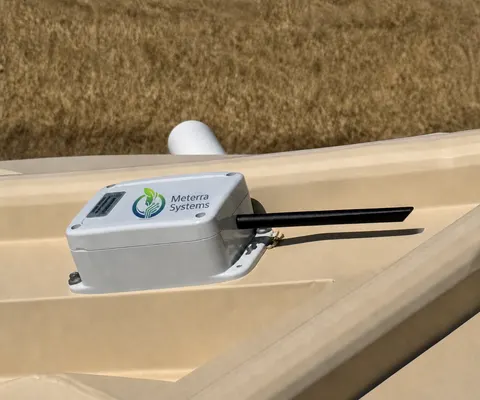
To monitor livestock water remotely, mount a wireless sensor above each tank, trough, or dam so it measures the water level and sends it — plus a low-water alarm — to your phone over the cellular network. The sensor needs no power and no Wi-Fi at the tank, and you set a threshold so you get an alert the moment the water drops too low. That replaces the daily drive and warns you about an empty tank before your cattle find it.
What “remote monitoring” actually means
Remote livestock water monitoring means a sensor at each watering point reports the water level to your phone on a schedule, and alerts you the moment the level crosses a line you set. Instead of driving a loop to look in every tank, you glance at an app — and you only drive out when a reading or an alarm tells you to. You manage water by exception rather than by windshield time.
It answers the one question a daily check is really for: is there water in the tank, and is it still going where it should? A dipstick or a drive-by gives you one data point a day; a monitor gives you the trend and tells you the moment something changes.
What you need
A complete setup has four parts, and understanding them is most of what you need to get started.
- A sensor at each point. Meterra uses an ultrasonic sensor that mounts above the water and measures the distance to the surface — nothing is submerged to corrode, foul, or freeze.
- Cellular connectivity. Readings travel over NB-IoT, a low-power network built for this. No Wi-Fi to reach the tank, no hub to power.
- A power source that takes care of itself. Battery life runs 2+ years, with solar an option where you want indefinite runtime. No wiring.
- The app and alarms. Live level, percent and volume, the history behind it, and the low-water alerts that actually change what you do that morning.
How to set it up, step by step
- Pick your first watering point. Start where a failure costs you most or where the drive is longest — the back tank, the trough on a stuck float, the dam you can’t see from the road.
- Mount the sensor above the water. It fixes to the top of a tank or a bracket over a trough or dam, pointing down at the surface — about 15 minutes with basic tools, no electrician.
- Let it connect. The sensor links to the cellular network on its own and starts reporting. Confirm coverage at the site first; for spots with no signal at all, satellite is the alternative.
- Set your thresholds. Choose the low-water level that should trigger an alarm — and a high level if overflow is a risk. This is the part that turns data into a warning.
- Add points as you see the value. Every new sensor lands in the same dashboard, so one screen covers the whole place — or several places.
Why it pays off
The cost of checking water the old way is fuel, labor, and risk. University extension estimates put the fuel alone for driving to check remote water at well over $1,500 a year on larger operations, before the hours or the truck wear. The bigger cost is the day a tank is empty and nobody knew: water is the most important nutrient a cow takes in, and a livestock water sensor with a low-water alarm protects condition and gains long before a visual check would. The next move is using that visibility to cut hauling trips and costs.
What to watch for when choosing a system
- Sensing matched to the vessel — non-contact ultrasonic on tanks (nothing submerged to foul), a sealed pressure sensor on troughs, dams, and ponds (reads under ice) — see ultrasonic vs. pressure sensors.
- Real cellular coverage at your actual watering points — confirm it before you buy, and factor the connectivity plan, not just the hardware.
- Multi-year battery and a solar option, so there’s no annual battery chase.
- One account for every sensor, so multiple tanks and multiple properties show on one screen.
The hardware this guide covers
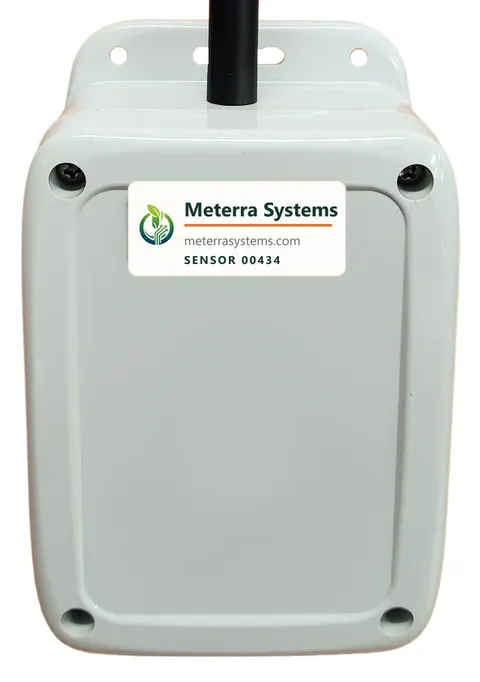
Every device reports to the same Meterra dashboard and app.
Tell us what you need to keep an eye on and we'll map the right sensors and coverage.
Frequently asked questions
How do you monitor livestock water remotely?
Put a wireless sensor on each tank, trough, or dam — a non-contact ultrasonic sensor above a tank, or a sealed submerged sensor in a trough, dam, or pond. It measures the level and sends it to your phone over the cellular network. You set a low-water threshold and get an alarm the moment the level drops below it, so you find an empty tank before your cattle do.
Do you need power or internet at the tank?
No. The sensors are battery or solar powered and report over Verizon NB-IoT cellular, so there's no mains power, no Wi-Fi, and no hub to install at the tank. That's what lets them work on the far side of a property where nothing else reaches.
How much water does a cow need, and why does that matter for monitoring?
A dry cow drinks around 12 gallons a day, rising to 20–24 gallons for a lactating, spring-calving cow (plus 5–10 for her calf) in 90°F heat, per University of Nebraska and Oklahoma State extension figures. Because demand peaks exactly when failures happen, a low-water alarm protects condition and gains before a visual check ever would.
Can I start with just one tank?
Yes. Most operations start with the most remote or most troublesome water point and add sensors over time. Every device reports into the same app, so the whole property ends up on one screen.
What does remote livestock water monitoring cost?
In our US rollout, sensors start at $299 for the Tank Level Sensor, $399 for the Trough Level Monitor, and $499 for the Dam Level Monitor, each including three months of connectivity and full app access; connectivity is then from $10/month per device, with discounts on annual subscriptions. Multi-tank setups scale per sensor — send your details or call and we'll size the whole property.
Related Meterra pages
- Meterra vs. Trough D Tech: a sourced, price-for-price comparison with SensorTech's trough monitor.
- Livestock Water Monitoring: the full overview of monitoring water across a ranch.
- Tank Level Sensor: the wireless ultrasonic sensor for any stock or supply tank.
- Trough Level Monitor: empty-trough alarms for watering points.
- How to Cut Water-Hauling Trips and Costs: the next step once you can see every tank.
- How Much Water Do Cattle Drink Per Day?: the demand numbers that size your tanks and alarms.
- Trail Camera vs. Water Level Sensor: weighing the budget alternative honestly.
- Do Water Sensors Need Power or Wi-Fi?: how battery and cellular sensors run where there is no outlet or router.
- How to Choose a Remote Water Monitoring System: the questions that separate a good fit from a poor one.